USAID DEC
Strengthening Health Systems: Measuring Social and Behaviour Change Communication Capacity in Malawi
Sign inFHI 360
Strengthening Health Systems: Measuring Social and Behaviour Change Communication Capacity in Malawi
Health promotion in Malawi has been evolving to address the country's high burden of disease, including HIV/AIDS, malaria, and tuberculosis.
2018 · 5 pages
Sign in to readA free account is required to download.
Abstract
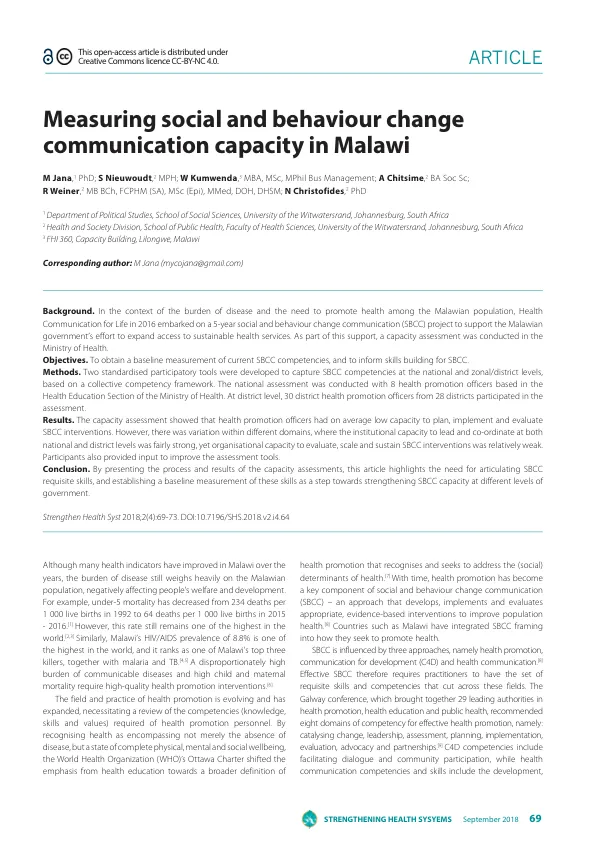
The World Health Organization's Ottawa Charter emphasizes the importance of addressing social determinants of health, shifting the focus from health education to a broader definition of health promotion. This approach has become a key component of social and behavior change communication (SBCC), which aims to develop, implement, and evaluate evidence-based interventions to improve population health. SBCC is influenced by three approaches: health promotion, communication for development (C4D), and health communication. Effective SBCC requires practitioners to possess a set of skills and competencies that cut across these fields. The Galway conference recommended eight domains of competency for effective health promotion, including catalyzing change, leadership, assessment, planning, implementation, evaluation, advocacy, and partnerships. A capacity assessment was conducted in the Ministry of Health to measure the current SBCC competencies of health promotion officers. The assessment showed that health promotion officers had low capacity to plan, implement, and evaluate SBCC interventions. However, there was variation within different domains, with institutional capacity to lead and coordinate at both national and district levels being fairly strong, but organizational capacity to evaluate, scale, and sustain SBCC interventions being relatively weak. The assessment used two standardized participatory tools to capture SBCC competencies at the national and zonal/district levels. The tools contained four discrete domains of competency: institutional systems, planning and designing, implementation and monitoring, and evaluating, scaling, and sustaining. The assessment was conducted with 8 health promotion officers at the national level and 30 district health promotion officers from 28 districts at the district level. The results of the assessment highlighted the need for articulating SBCC requisite skills and establishing a baseline measurement of these skills as a step towards strengthening SBCC capacity at different levels of government. The assessment also provided input to improve the assessment tools. The findings of the assessment have implications for SBCC capacity-strengthening efforts, emphasizing the importance of competent and motivated human resources in achieving high-quality SBCC interventions. The Malawian government's efforts to increase demand for and expand access to quality and sustainable health services are supported by a 5-year SBCC project implemented by Health Communication for Life. The project aims to strengthen the capacity of health and non-health practitioners in health promotion and SBCC. The capacity assessments conducted as part of this project provide a baseline measurement of SBCC competencies and inform skills-building for SBCC. The assessments highlight the need for a clear idea of the requisite skill sets and their baseline measurement at different levels. The institutional systems within the Ministry of Health play a crucial role in leading, coordinating, and harmonizing health promotion activities. The capacity assessment showed that the institutional systems within the Ministry of Health were essential for SBCC, but there was a need for strengthening these systems to improve the capacity of health promotion officers. The assessment also highlighted the importance of planning and designing SBCC interventions, implementation and monitoring, and evaluating, scaling, and sustaining these interventions. The findings of the capacity assessment have implications for SBCC capacity-strengthening efforts in Malawi. The assessment highlights the need for articulating SBCC requisite skills and establishing a baseline measurement of these skills as a step towards strengthening SBCC capacity at different levels of government. The assessment also provides input to improve the assessment tools and highlights the importance of competent and motivated human resources in achieving high-quality SBCC interventions.
Related documents