FHI 360
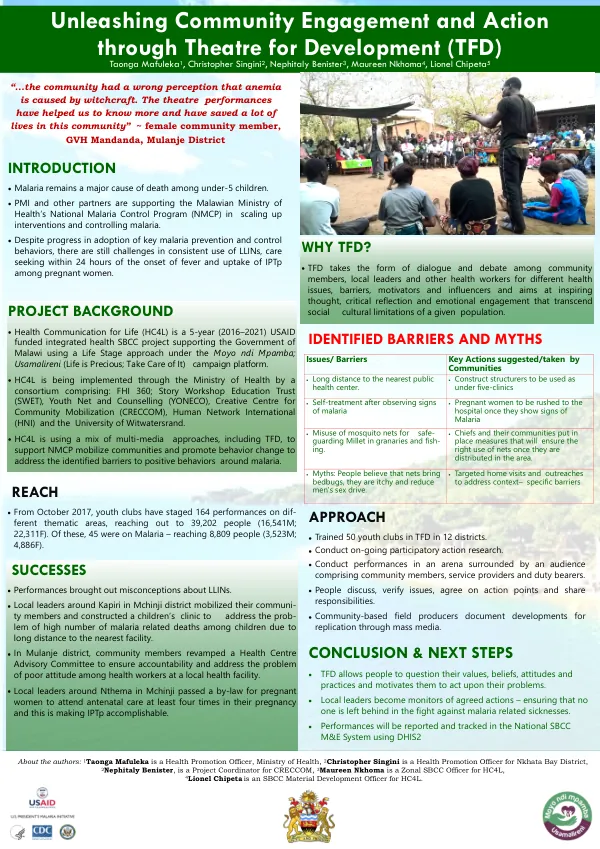
Unleashing Community Engagement and Action through Theatre for Development (TFD)
The Health Communication for Life (HC4L) project in Malawi is a 5-year initiative funded by USAID, supporting the Government of Malawi's National Malaria Control Program (NMCP) through the Moyo ndi Mpamba; Usamalireni campaign platform.
2018 · 1 pages
Sign in to readA free account is required to download.
Abstract
The project is implemented through a consortium of organizations, including FHI 360, Story Workshop Education Trust, and the University of Witwatersrand, among others. HC4L utilizes a mix of multi-media approaches, including Theatre for Development (TFD), to mobilize communities and promote behavior change to address barriers to positive behaviors around malaria. The TFD approach involves training youth clubs in 12 districts, conducting participatory action research, and staging performances in arenas surrounded by community members, service providers, and duty bearers. The performances aim to bring out misconceptions and inspire critical reflection, emotional engagement, and action among community members. Community-based field producers document developments for replication through mass media. The project has achieved several successes, including performances that brought out misconceptions about Long-Lasting Insecticidal Nets (LLINs). Local leaders in Kapiri, Mchinji district, mobilized their community members to construct a children's clinic to address the problem of high malaria-related deaths among children due to long distances to the nearest facility. In Mulanje district, community members revamped a Health Centre Advisory Committee to ensure accountability and address the problem of poor attitude among health workers at a local health facility. The project has also reached a significant number of people, with 164 performances staged on different thematic areas, reaching 39,202 people, including 45 performances on malaria, reaching 8,809 people. The project has identified several barriers and myths, including long distances to the nearest public health center, misuse of mosquito nets, and misconceptions about the use of LLINs. The TFD approach is effective in inspiring thought, critical reflection, and emotional engagement among community members, local leaders, and health workers. It allows people to question their values, beliefs, attitudes, and practices and motivates them to act upon their problems. Local leaders become monitors of agreed actions, ensuring that no one is left behind in the fight against malaria-related sicknesses. The project's successes have been documented through community feedback, including a statement from a female community member in Mulanje District, who attributed the reduction in anemia-related deaths to the TFD performances. The project's findings and recommendations will be reported and tracked in the National SBCC M&E System using DHIS2.