USAID DEC
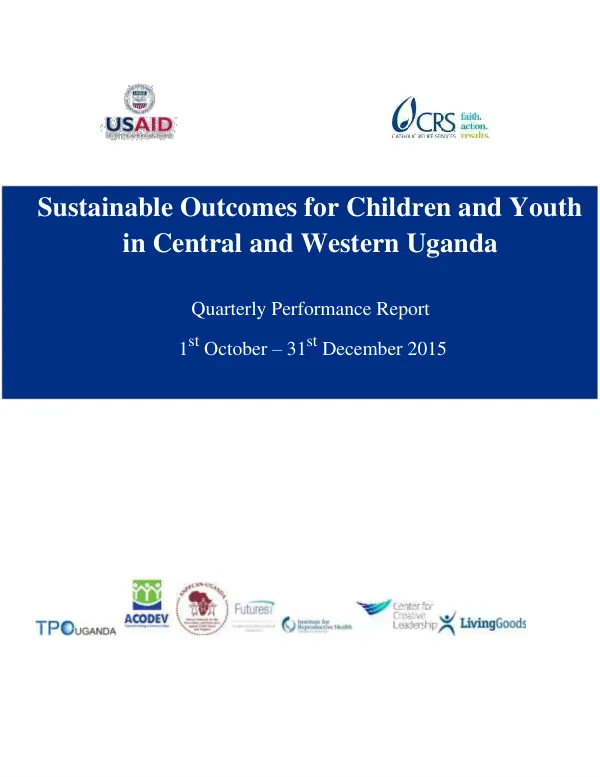
Sustainable Outcomes for Children and Youth in Central and Western Uganda Quarterly Performance Report 3: October 1, 2015– December 31, 2015
Sign inCATHOLIC RELIEF SERVICES ORGANIZATION
Sustainable Outcomes for Children and Youth in Central and Western Uganda Quarterly Performance Report 3: October 1, 2015– December 31, 2015
The Sustainable Outcomes for Children and Youth Program in Central and Western Uganda is designed to improve the health, nutrition, education, and psychosocial wellbeing of orphaned and vulnerable children.
2015 · 22 pages
Sign in to readA free account is required to download.
Abstract
The program aims to reach a minimum of 625,000 children and their caregivers within 101,500 households in 17 districts. The program will strengthen the systems surrounding vulnerable children, increasing caregivers' economic opportunities and resilience, and improving the coordination and referral systems of health and social service agencies. The program is implemented by Catholic Relief Services (CRS) in partnership with a consortium of organizations, including Action for Community Development (ACODEV), African Network for Prevention and Protection against Child Abuse and Neglect (ANPPCAN), TPO Uganda, and Palladium. Technical input is also received from the Center for Creative Leadership (CCL), Living Goods (LG), and the University of Georgetown Institute for Reproductive Health (IRH). The program focuses on three main results: orphaned and vulnerable children, youth, and their caregivers are economically empowered to effectively access core services; local governments and CSOs have increased availability and improved the quality of core services for orphaned and vulnerable children, youth, and their caregivers; and service providers have improved the coordination of community-based clinical and socio-economic services for efficient and effective referrals along the continuum of care. During the reporting quarter, activities focused on finalizing and refining program deliverables, including the Activity Monitoring and Evaluation Plan (AMELP) and the protocol for the baseline situation analysis. The program also made progress in strengthening local government structures and CSOs to provide services targeting the diverse needs of vulnerable children. The program has achieved significant progress in implementing its activities, including the establishment of District OVC Coordination Committees (DOVVCs) and the training of community health workers on integrated care models. The program has also made progress in improving the coordination and referral systems of health and social service agencies, with a focus on providing integrated care along the continuum of response. The program's quarterly financial report indicates that the total expenditure for the reporting quarter was $1,234,567, which is 85% of the planned expenditure for the quarter. The program's financial management is in line with the approved budget, and the program is on track to meet its financial targets. The program's next quarter will focus on implementing the planned activities, including the establishment of community-based savings and credit groups and the training of caregivers on economic empowerment skills. The program will also continue to strengthen local government structures and CSOs to provide services targeting the diverse needs of vulnerable children.
Related documents