ARIZONA STATE UNIVERSITY
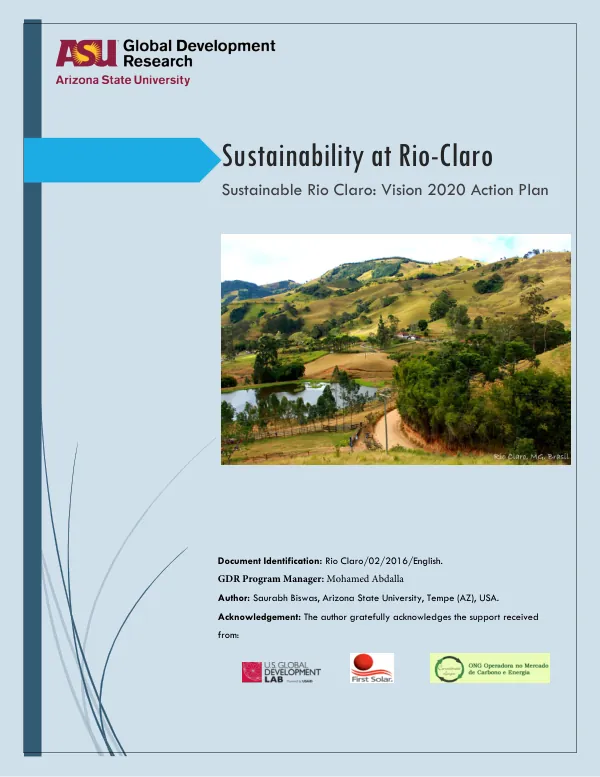
Sustainable Rio Claro: Vision 2020 Action Plan
Sustainable Rio Claro: Vision 2020 is an initiative of the people of Rio Claro, a village in the Delfim Moreira municipality in Minas Gerais, Brazil.
2016 · 21 pages
Sign in to readA free account is required to download.
Abstract
The community, comprising nearly 100 houses, farms, and plantations, has a population of 314. Rio Claro is known for its milk production, and its residents are hardworking and ingenious. They are a progressive community that believes in moving with times while maintaining their own identity, created over several decades. The community has experienced dramatic reductions in river and fresh spring water levels during the dry season, and municipal services have not yielded optimum results for the community in terms of proper roads, healthcare, or education facilities. A combination of factors has increased the ecological and social risks to their overall well-being. Concerned citizens, students, and non-profit agencies have come together to address this challenge through a transformative approach and to achieve the shared vision of Sustainable Rio Claro: Vision 2020. The well-being of individuals and families is central to the idea of a sustainable community, which in turn depends heavily on nature's endowment to it. Rio Claro takes pride in its identity as a community, which has been cultivated through traditions and culture over many decades. Their relationship with the land, water, flora, and fauna is special. To sustain this, it is essential that citizens have agency to participate and influence decision-making. The five key dimensions to this are: sustainability for the people and families, sustainability of natural resources, sustainability of livelihood and opportunity, sustainability for their children and youth, and sustainability of their identity and way of life. The Sustainable Rio Claro: Vision 2020 is a bold visualization of an ideal future state. The elements in this vision are a reflection of the definition of sustainability that residents of Rio Claro identify with. The timeframe for realizing this vision is by the year 2020, implying the urgency to rapidly transform. The program is based on the Clean Energy Enterprise enabled Sustainable Transformation framework, which works towards transforming rural and peri-urban communities for sustainable outcomes, enabled by clean energy enterprise that fosters microeconomic stability. The framework is designed for an interventional approach to address specific sustainability issues faced by the targeted communities. The program areas for Phase-I of implementation include water, sanitation and wastewater, solid waste, energy, health risk mitigation, and sustainability thinking and dialogue. Estimated budget outlay for Phase-I is approximately BRL 120,000.00 (~ USD 36,000.00). The residents' association, young students, and community members are taking the lead in coordinating the implementation effort, with support from ONG Consciencia Limpa, U.S Global Development Lab, and Saurabh Biswas (Doctoral Researcher, Arizona State University). The initiative is adopted by the people of Rio Claro to transform their community to one that is equipped to deal with changing times and aspirations, ensuring sustainability of humans and ecology by addressing direct and indirect risks to them. The motivation for creating and realizing this vision comes from the keen desire to determine their own destiny and minimal dependence on the institutional mechanism that has not delivered. Leading the initiative, motivated and enthusiastic volunteers have assumed responsibility for individual aspects, supported by the experience and traditional knowledge of the residents of Rio Claro. Strategy for addressing the risks identified is being developed so that the desired goals are achieved in the shortest possible time, creating positive impact for all.