U.N. WOMEN
The Time is Now to Accelerate Women's Public Procurement: Case Study: Nigeria
Nigeria recognizes the urgency to involve more women-owned businesses in the economy.
2021 · 5 pages
Sign in to readA free account is required to download.
Abstract
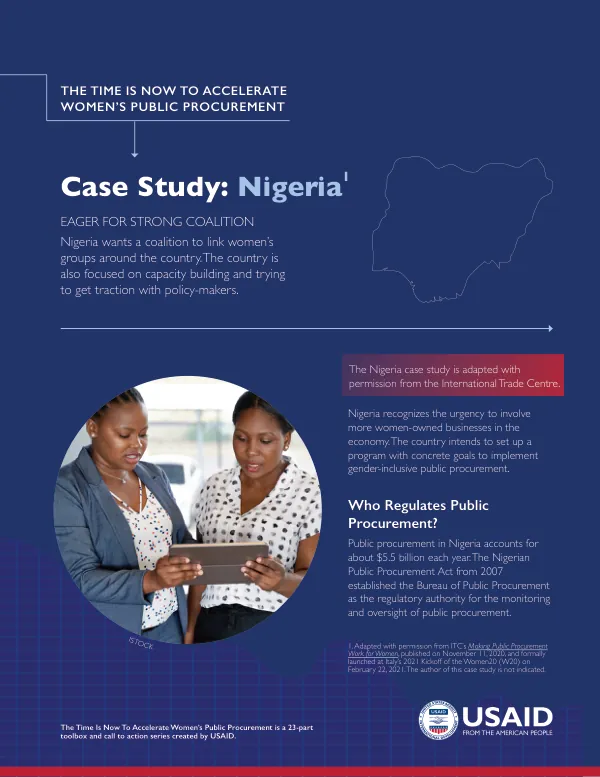
The country intends to set up a program with concrete goals to implement gender-inclusive public procurement. Public procurement in Nigeria accounts for about $5.5 billion each year. The Nigerian Public Procurement Act from 2007 established the Bureau of Public Procurement as the regulatory authority for the monitoring and oversight of public procurement. The Nigeria case study is one of five case studies demonstrating how five countries have worked on gender-inclusive public procurement. The country is focused on capacity building and trying to get traction with policy-makers. Nigeria wants a coalition to link women's groups around the country. The country is also keen to pursue gender-inclusive procurement through a preferential policy, with the support of the SheTrades Initiative. The Nigeria Public Procurement Act 2007 and two public procurement regulations are in place. The Act established two regulatory authorities, the National Procurement Council and the Bureau of Public Procurement, situated in the federal government. The Act determines that procuring entities may grant a preference margin to domestic contractors and suppliers of goods manufactured in Nigeria, in the case of international bidding contracts. However, neither the Act nor the Regulations provide preferential treatment for women. Businesses find procurement requirements to be excessive, and communication and training are required. Internet access is insufficient, and women-owned businesses consider the request for audited accounts often to be unreasonable. They are not allowed to submit joint bids in which the track record of one party qualifies for a combination or consortium of bidders. This stands in the way of gaining experience by teaming up with a more experienced partner. The main barrier experienced by women-owned businesses relates to excessive requirements. Businesses consider the request for audited accounts often to be unreasonable. They are not allowed to submit joint bids in which the track record of one party qualifies for a combination or consortium of bidders. This stands in the way of gaining experience by teaming up with a more experienced partner. In the category "misfit tender design," closing markets for competition due to long-term agreements was deemed the most urgent barrier to address. Nigeria does not have a central register of women-owned businesses. This makes it hard for procuring entities to reach them and for women-owned businesses to connect and collaborate. The Bureau of Public Procurement explained that businesses can register for participation in government tenders. Many women-owned businesses are not listed in this register, but by doing so, they can become visible to procuring entities. Several steps are required to pursue gender-inclusive procurement in Nigeria. Determine which institutions will take the lead, and one or a combination of government institutions must take ownership. Based on the series of stakeholder consultations on the draft Gender-Responsive Public Procurement Policy, participants agreed that a program has to be put together at the federal level and applied to the whole of Nigeria. Draft an action plan once lead institutions are officially appointed. The Ministry of Women's Affairs and Social Development, NEPC, the Bureau of Public Procurement, and several women's business associations participated in the stakeholder consultations, which took place from January 2020 to March 2021.