GOVERNMENT OF COLOMBIA
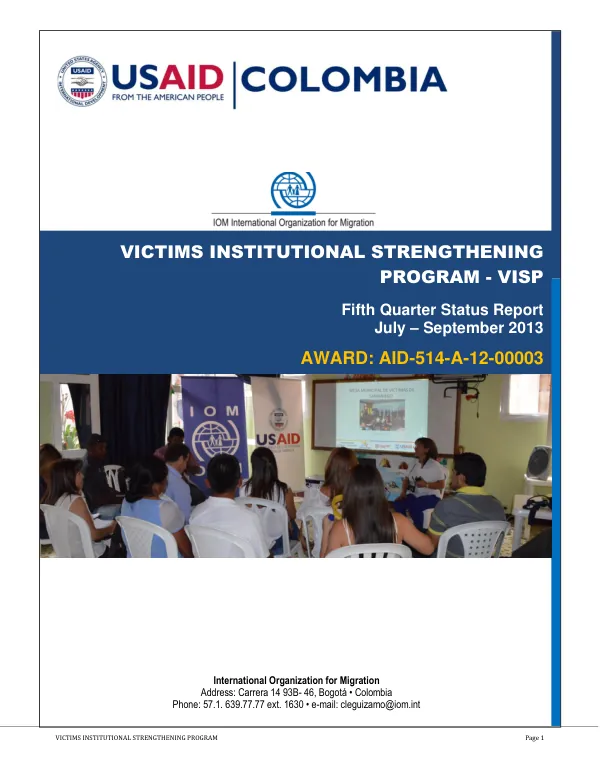
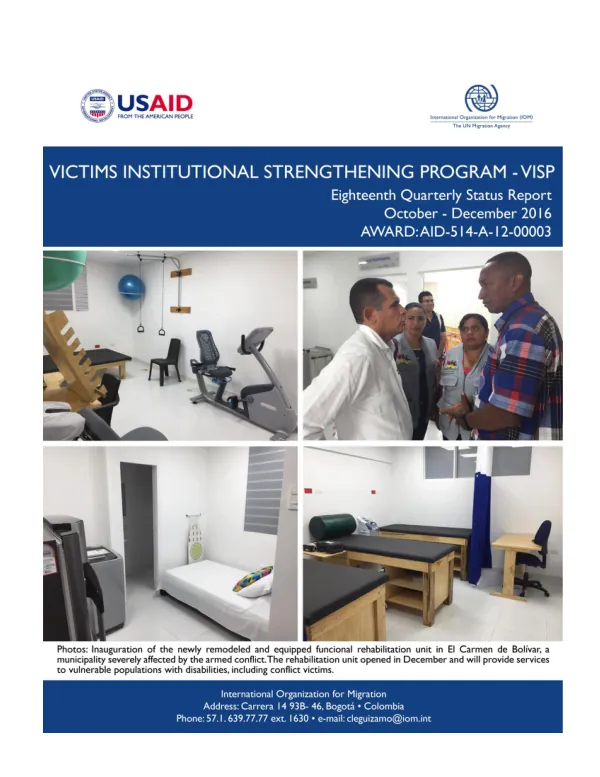
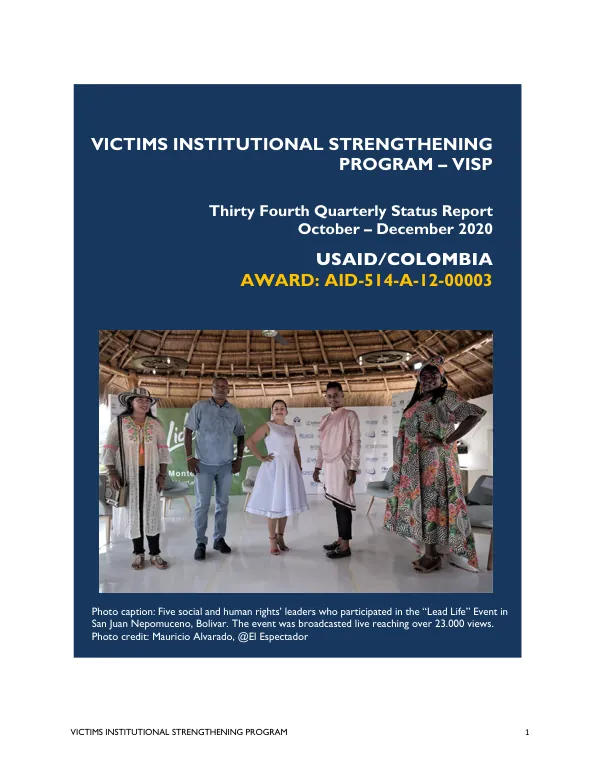
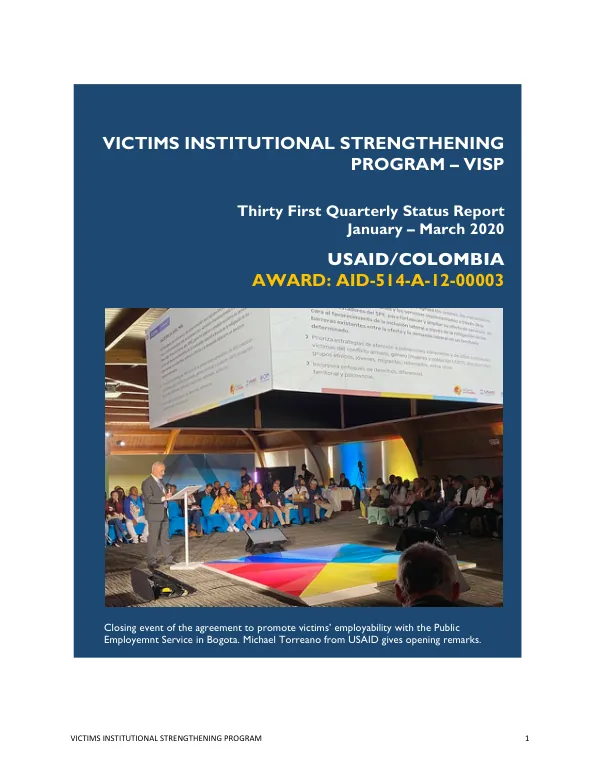
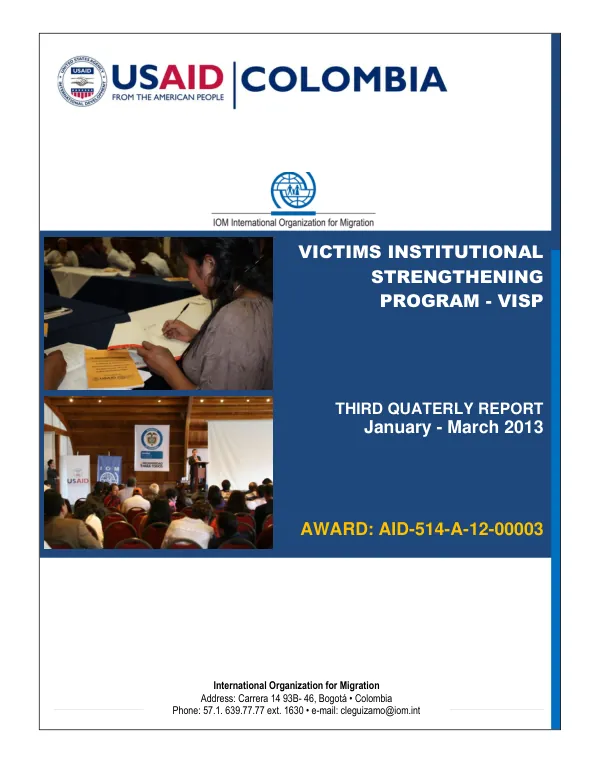
Third Quaterly Report: Victims Institutional Strengthening Program - VISP
The Victims Institutional Strengthening Program (VISP) Work Plan was approved on December 4, 2012, marking the official beginning of VISP implementation.
2013 · 30 pages
Sign in to readA free account is required to download.
Abstract
Departmental visits were completed in the first quarter of 2013, allowing USAID, strategic partners, and the VISP team to present the program to local stakeholders and engage them in dialogue on the needs, opportunities, and obstacles to be confronted during VISP implementation. One of the first projects initiated in this quarter was the national media campaign, Repair to Move Forward (Reparar para Seguir). This campaign has been vital in positioning the Victims Unit as the principal entity responsible for the attention and comprehensive reparation to victims. The development and formulation of sub-projects to be implemented with strategic partners, particularly the Victims Unit, the Historical Memory Center (CMH), and the Ministry of Health (MOH), continued. At the close of this reporting period, VISP had 34 project factsheets coordinated with partners and reviewed by USAID for a total of approximately USD 8.7 million. During the reporting period, VISP was able to solidify two new projects, one with the Victims Unit and the other with the National Planning Department, for a total of approximately USD 2.2 million. The projects are geared towards communication and Indigenous and Afro-Colombian populations and amplify the programmatic reach of VISP. VISP opened departmental offices and selected coordinators, working closely with regional Victims Unit Offices, Governor's and Mayor's Offices, the Public Ministry, and in certain cases with Indigenous Authorities to identify gaps, formulate institutional strengthening interventions, attract the attention of public officials, and manage interventions aimed at victims' reparations and services. The report highlights advances made on the Program's PMP indicators with quarterly reporting requirements, reflecting advances in the first quarter of implementation. The report also includes news articles and updates on victims and VISP topics. The financial report includes implemented and committed funds, with a total confirmed funding of USD 28,870,064, total funds received to date of USD 1,850,000, and total expenditures of USD 2,416,946. Key contextual developments that impact the Program took place, including the health sector crisis and the ongoing peace process between the Government of Colombia (GOC) and FARC. Article 136 of the Victims Law established the GOC's responsibility to implement the Victims Psychosocial and Comprehensive Health Program (PAPSIVI) within six months. However, almost two years later, victims still do not have a specific program for psychosocial rehabilitation and services or comprehensive health in the health system. The delay is primarily a result of the general crisis in the health sector and efforts to achieve consensus regarding reform. Rehabilitation only gained relative importance within the National Victims Assistance and Reparation System (SNARIV) Executive Committee in January of this year when the president highlighted the urgency for an immediate psychosocial response for victims of sexual violence. In April, President Santos reiterated the urgent need for PAPSIVI to be fully operational by the end of May 2013. Progress on PMP quarterly indicators for the reporting period can be found in Annex 2. Qualitative progress through March 31, 2013, in accordance with the approved PMP and work plan, is described below. Intermediate Result 1: Improved GOC strategic management for victims Law has seen progress, with the institutional strengthening of the Victims Unit and the development of sub-projects to be implemented with strategic partners. Intermediate Result 2: Improved GOC rehabilitation services that strengthen victims' capacity to fully exercise their rights and responsibilities has also seen progress, with the development of the PAPSIVI program and the deployment of inter-disciplinary teams to target municipalities. Intermediate Result 3: Transitional justice processes advanced, with the organization of regional roundtables on victims' issues to be organized by Congress in May, accompanied by the United Nations, and receiving technical support from VISP. Intermediate Result 4: Select GOC institutions and systems accommodate the specific needs of ethnic groups and women has seen progress, with the development of sub-projects to be implemented with strategic partners, particularly the Victims Unit, the CMH, and the MOH. The report concludes with a financial report, including implemented and committed funds.