USAID DEC
Transforming Evidence to Action: The Case of Election Participation in Nigeria
The Transforming Evidence to Action (TEA) program is a novel initiative of the Laboratory for Interdisciplinary Statistical Analysis (LISA) at the University of Colorado Boulder and the statistics and data science collaboration laboratories (stat labs) of the LISA 2020 Network.
2021 · 16 pages
Sign in to readA free account is required to download.
Abstract
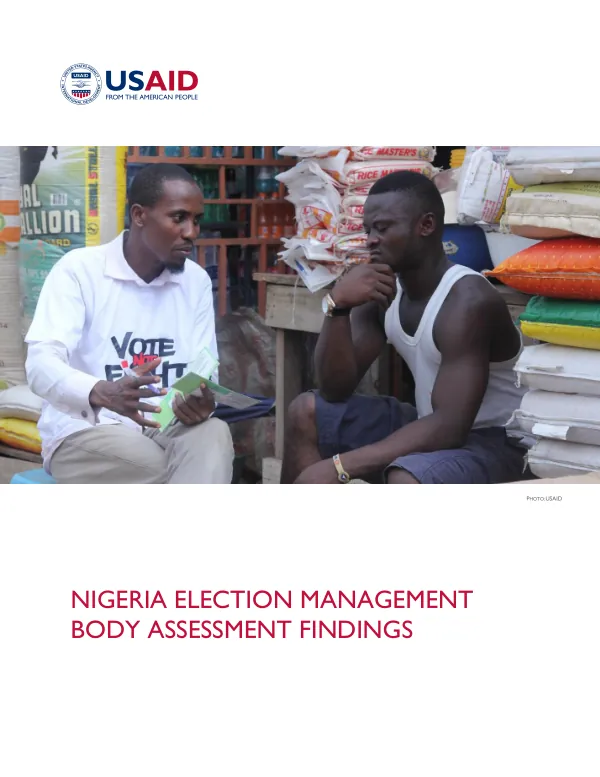
Funded by the U.S. Agency for International Development, the program aims to create institutional statistical analysis and data science capacity to enable and accelerate local solutions for local development challenges. The TEA program operates in a space occupied by three development actors: data producers, data decision makers, and data analyzers. Stat labs provide collaborative statistics and data science expertise to bring all of the actors together to produce evidence and transform it into action for development. A case study in TEA was conducted in Nigeria to aid formulation of a national electoral policy to strengthen democracy. The University of Ibadan Laboratory for Interdisciplinary Statistical Analysis (UI-LISA) was established in March 2015 to become the third stat lab in the LISA 2020 Network. The stat lab's overarching vision is to build statistics and data science capacity in Nigeria. The primary function of UI-LISA is to train statistics students to employ the power of statistics to solve societal problems and become effective interdisciplinary collaborators. The development challenge in Nigeria is enhancing electoral participation, which has been a hydra-headed problem due to various events connected to the voting process. A seven-member team from UI-LISA collaborated with The Electoral Institute (TEI) to investigate the factors responsible for voters' apathy and answer policy questions related to the quality of the voter register, the conduct of the CVR exercise, the conduct of the voting exercise, and the measurement of the turnout rate and quality of census data. A nationally representative sample survey was conducted covering six states in Nigeria, with 2,160 registrants and 1,080 eligible but not registered citizens interviewed. The participants were asked to respond to a three-part questionnaire covering topics on CVR, accreditation, and voting participation. Electoral data from the records of INEC and other sources were also interrogated to identify factors, issues, and events that may have impacted electoral participation. The study revealed that the low participation rate is a complex issue, and addressing it requires finding answers to several key policy questions. The results of the study will aid in the formulation of a national electoral policy to strengthen democracy in Nigeria. The TEA program has tremendous potential to enable and accelerate data-driven development, and this case study demonstrates its effectiveness in addressing development challenges in Nigeria.
Related documents
Documents in this collection
 2021
2021USAID DEC
Diet diversity among pregnant women and young children—Insights for improving malaria, family planning, and maternal and child health outcomes in northwestern Nigeria through social and behavior change programming
Open record 2021
2021USAID DEC