CARE
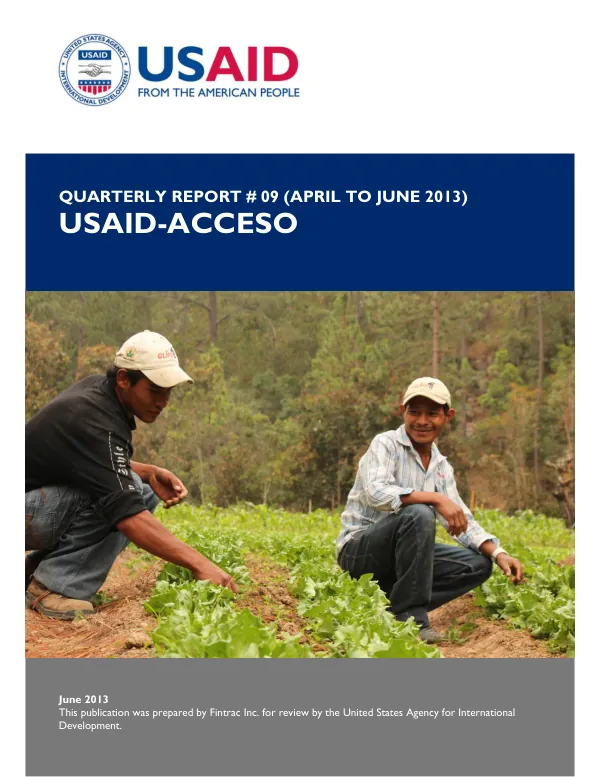
USAID-ACCESO Quarterly Report #09 (April to June 2013)
The agricultural development initiative in Honduras, known as USAID-ACCESO, is a 46-month project funded by the United States Agency for International Development (USAID) Office of Economic Growth.
2013 · 54 pages
Sign in to readA free account is required to download.
Abstract
The project aims to move rural Honduran households out of extreme poverty and under-nutrition by improving their incomes. USAID-ACCESO represents the core investment by USAID/Honduras in the US government's global hunger and food security initiative known as Feed the Future. The project is working through six key components to enable economic development at the household level. These components include technical assistance and training to enhance the capacity of Honduras' poorest households in production, management, and marketing skills; market access focused on linking farmers to market opportunities; rural financial services through existing rural financial intermediaries, village banks, commercial banks, and other service and input providers; assistance in eliminating policy barriers that impede rural household access to market opportunities; malnutrition prevention activities to enhance the capacity of rural households to improve utilization and consumption of healthy food; and sound environmental and natural resource management. USAID-ACCESO is implemented by the US agribusiness firm Fintrac Inc., in association with Fundación Hondureña de Investigación Agrícola (FHIA), Escuela Agrícola Panamericana (EAP-ZAMORANO), Fundación para el Desarrollo Empresarial Rural (FUNDER), CARE International, and the Global Village Project. Other local nongovernmental organizations (NGOs) were subcontracted during the first three quarters of implementation, and are now directly implementing activities under USAID-ACCESO. During the reporting period from April to June 2013, activities focused on completing recruitment of client households with interest and ability to participate in market-based production and nutrition activities; strengthening and expanding the delivery of technical assistance and training to client households on production technologies to increase productivity in corn, beans, and coffee, to introduce high-value horticultural crops, and to expand market-driven calendarized production programs, including contract production of yellow corn for the local industry; developing new products; increasing productivity and reducing unit production costs for new and existing micro, small, and medium-sized on- and off-farm enterprises; increasing access to markets, buyers, and logistics; opening new and expanding existing finance options for project clients; completing existing and establishing new renewable energy and natural resource management projects among production and nutrition client households; continuing data collection and ensuring data quality; implementing strategies to improve the nutritional status of children under two years of age; and integrating project components at the household and community level to ensure impact of project activities on family livelihoods. Highlights this quarter include the recruitment of 3,443 new client households, bringing the total to 34,920 client households with more than 188,000 family member beneficiaries. The demographic and income data collected in 18,746 client household profiles indicate that 89 percent of the clients are categorized as extreme poor and poor, and 11 percent as non-poor. A total of 81,998 technical assistance visits were conducted during the quarter, for a total of 305,756 to date. In addition, 4,028 new individuals participated in training activities during the quarter, for a total of 36,688 individuals to date. As part of the market-driven production program, 4,573 new hectares were planted this quarter. Of the current total of 34,150 hectares receiving project technical assistance, 17,946 are coffee, 13,277 are basic grains, and 2,927 hectares are high-value fruit and vegetable production. As of June 2013, 1,044 improved stoves, 253 solar dryers, 82 bio-digesters, 34 solar energy systems, and 1 hydraulic ram pump for a total of 1,414 renewable energy systems had been installed among project client households.