INTERNATIONAL MEDICAL CORPS
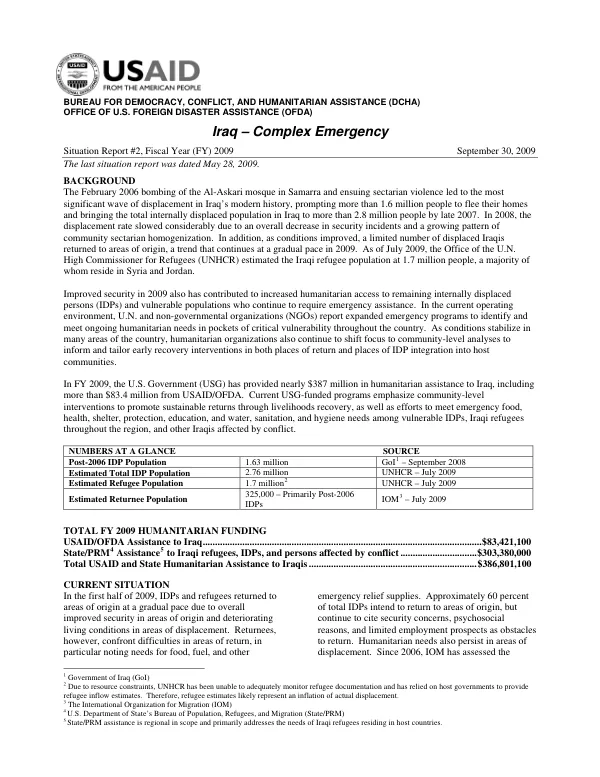
USAID-DCHA Iraq Complex Emergency Situation Report #1
The complex emergency in Iraq has been ongoing since the February 2006 bombing of the Al-Askari mosque in Samarra, resulting in the displacement of over 2.8 million people by late 2007.
2009 · 5 pages
Sign in to readA free account is required to download.
Abstract
The displacement rate slowed in 2008 due to improved security and community sectarian homogenization, with a limited number of displaced Iraqis returning to areas of origin. As of early May 2009, the International Organization for Migration (IOM) estimated the internally displaced population at approximately 2.5 million Iraqis. Improved security in 2009 has contributed to increased humanitarian access to remaining internally displaced persons (IDPs) and vulnerable populations. The U.N. and non-governmental organizations (NGOs) report expanded programs, precise beneficiary targeting, and improved understanding of the conditions required to accelerate and sustain IDP and refugee returns to home communities. The U.S. Government has provided more than $527 million in humanitarian assistance to Iraq, including $100 million from USAID's Office of U.S. Foreign Disaster Assistance (OFDA). The humanitarian needs of IDPs and refugees persist, with access to employment, shelter, and food identified as priority needs. Since 2006, IOM has assessed the changing humanitarian conditions among IDPs, with the majority identifying access to employment as the priority need. The recent decision by the Government of Iraq (GoI) to cease IDP registrations could exacerbate humanitarian needs among Iraqis attempting to register as IDPs in order to receive government distributions. Returns to areas of origin have been gradual, with nearly 50,000 returnee families identified by IOM in late March 2009. An estimated 7 percent of total returnees represent refugees from surrounding countries, primarily Syria, returning to Anbar and Baghdad governorates. The remaining returnees were displaced internally between 2006 and 2008 and returned to areas of origin throughout Iraq. Of the total returnee population, nearly 270,000 individuals returned to home communities in Baghdad, Anbar, and Diyala governorates. According to IOM, improved security has led to the return of 36 percent of total returnees to areas of origin, while influencing an additional 36 percent who also cited difficult living conditions in areas of displacement as motivation to return. However, limited access to jobs, housing, and basic services continues to preclude large-scale movements to some home communities. As of April 2009, more than 60 percent of the returnee population reported insufficient access to food, nearly 40 percent cited a lack of safe drinking water, and more than 50 percent noted inadequate quantities of fuel and other essential supplies upon returning home. To address the difficult environment facing returnees, the humanitarian community continues to advocate for targeted humanitarian interventions in current and anticipated areas of return. Objectives include meeting the humanitarian needs of the existing returnee caseload, encouraging additional returns by improving overall conditions, and ensuring the sustainability and durability of solutions in order to prevent reoccurring displacements in the future. To date in FY 2009, USAID/OFDA has provided nearly $5.1 million to support sustainable returns, with a focus on providing emergency relief supplies, improving water, sanitation, and hygiene facilities, and offering protection services in areas of return.
Related documents