ACTION CONTRE LA FAIM
USAID-DCHA Sudan Fact Sheet #3
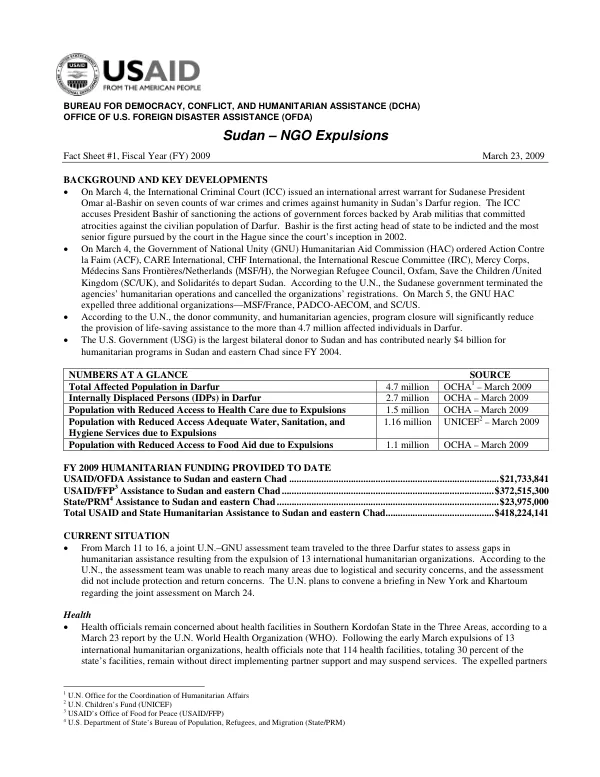
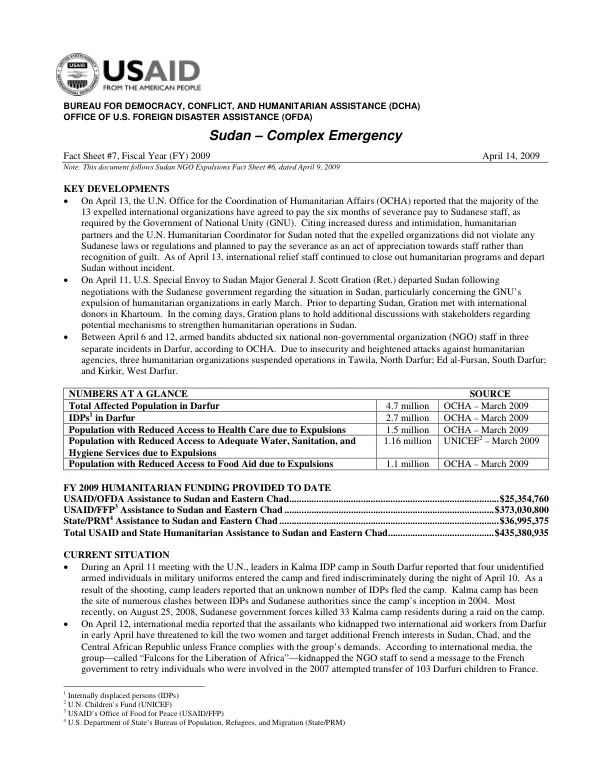
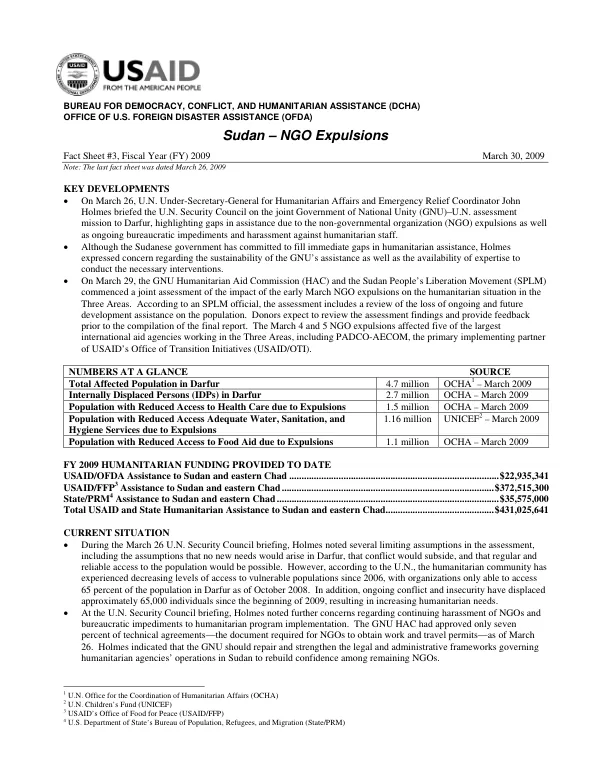
The humanitarian situation in Sudan, particularly in Darfur, has been severely impacted by the expulsion of non-governmental organizations (NGOs) by the Sudanese government.
2009 · 4 pages
Sign in to readA free account is required to download.
Abstract
The expulsions, which occurred in early March, have resulted in a significant reduction in humanitarian assistance to the affected population. According to the U.N. Office for the Coordination of Humanitarian Affairs (OCHA), the total affected population in Darfur is approximately 4.7 million people, with 2.7 million internally displaced persons (IDPs). The expulsions have had a devastating impact on the delivery of essential services, including health care, nutrition, and water, sanitation, and hygiene (WASH). The U.N. World Health Organization (WHO) has reported a significant increase in meningitis cases in Darfur, with 348 cases recorded in the 10 northern states of Sudan as of March 20. In response to the outbreak, WHO, UNICEF, and the South Darfur State Ministry of Health (MOH) vaccinated over 20,000 people for meningitis in Bielel IDP camp in South Darfur. The nutrition situation in Darfur is also critical, with a global acute malnutrition (GAM) rate of 10.4 percent and a severe acute malnutrition (SAM) rate of 1.2 percent reported in West Darfur. The early March NGO expulsions have significantly diminished nutrition capacity in West Darfur, including staff availability. According to the joint GNU-U.N. assessment mission to Darfur, the expulsions reduced the number of health and nutrition personnel in West Darfur from 444 to 192 medical staff. The U.S. Government (USG) is the largest bilateral donor to Sudan and has contributed over $4 billion for humanitarian programs in Sudan and eastern Chad since FY 2004. USAID/OFDA and USAID/FFP have provided over $1.1 billion in food and non-food humanitarian assistance to Sudan and eastern Chad in FY 2008 and to date in FY 2009. However, the expulsions have eliminated approximately 54 percent of USAID/OFDA's humanitarian programs in Darfur, 40 percent of the delivery capacity of USAID/FFP's main partner, the U.N. World Food Program (WFP), and shut down USAID/OTI's primary implementing partner PADCO-AECOM. The USG has provided significant humanitarian assistance to Sudan and eastern Chad in FY 2009. USAID/OFDA has provided $11.3 million in assistance to Darfur, including logistics and relief commodities, shelter and settlements, and humanitarian air service. USAID/FFP has provided $223.7 million in emergency food assistance to Darfur, while State/PRM has provided $13.4 million in protection and assistance for IDPs. The total USAID humanitarian assistance to Darfur in FY 2009 is $235.1 million, while the total USAID and State humanitarian assistance to Darfur in FY 2009 is $248.5 million.
Related documents