UNAIDS
USAID in Russia
USAID's assistance in Russia has spanned over two decades, with a focus on improving public health, protecting the environment, developing a stronger civil society, and modernizing the economy.
2012 · 2 pages
Sign in to readA free account is required to download.
Abstract
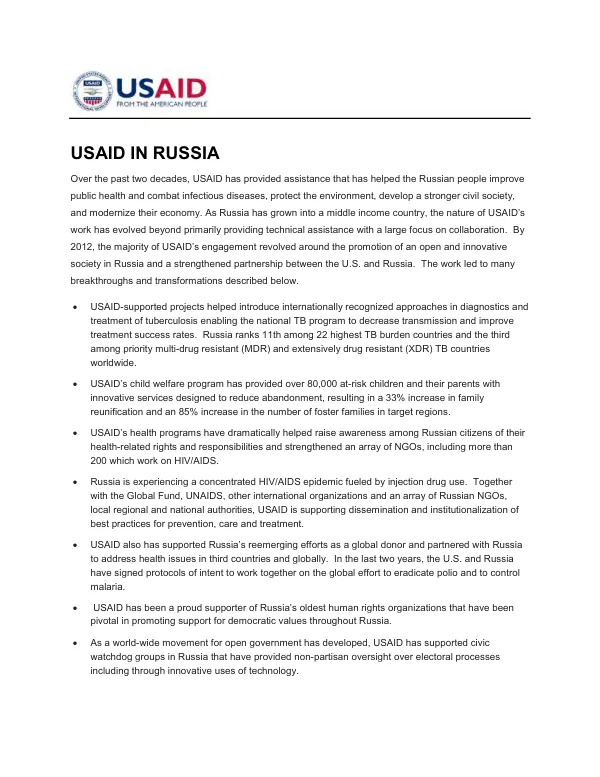
The nature of USAID's work has evolved over time, shifting from primarily providing technical assistance to promoting an open and innovative society in Russia and strengthening the partnership between the U.S. and Russia. One of the key areas of focus for USAID in Russia has been public health. USAID-supported projects have helped introduce internationally recognized approaches in diagnostics and treatment of tuberculosis, resulting in a decrease in transmission and improvement in treatment success rates. Russia ranks 11th among 22 highest TB burden countries and third among priority multi-drug resistant (MDR) and extensively drug resistant (XDR) TB countries worldwide. In addition to public health initiatives, USAID has also worked to support child welfare programs in Russia. The USAID child welfare program has provided over 80,000 at-risk children and their parents with innovative services designed to reduce abandonment, resulting in a 33% increase in family reunification and an 85% increase in the number of foster families in target regions. USAID's health programs have also helped raise awareness among Russian citizens of their health-related rights and responsibilities and strengthened an array of NGOs, including more than 200 that work on HIV/AIDS. Russia is experiencing a concentrated HIV/AIDS epidemic fueled by injection drug use, and USAID is supporting the dissemination and institutionalization of best practices for prevention, care, and treatment. Furthermore, USAID has supported Russia's reemerging efforts as a global donor and partnered with Russia to address health issues in third countries and globally. In the last two years, the U.S. and Russia have signed protocols of intent to work together on the global effort to eradicate polio and to control malaria. In the area of human rights, USAID has been a proud supporter of Russia's oldest human rights organizations, which have been pivotal in promoting support for democratic values throughout Russia. As a world-wide movement for open government has developed, USAID has supported civic watchdog groups in Russia that have provided non-partisan oversight over electoral processes, including through innovative uses of technology. USAID has also supported civil society organizations in Russia, whose number and influence have grown from 40 registered organizations in 1987 to approximately 300,000 today, not including state-funded public organizations. These organizations contribute to Russia's economic, political, and social life in numerous ways and provide opportunities for citizens to help create better communities and elevate their voices. In addition to these areas, USAID has helped foster the development of skills and relationships that have generated a more resilient information environment, especially as technology has evolved. Since 1992, USAID has supported the development of professional relationships between Russian and American journalists, publishers, electronic media managers, designers, content developers, advertising specialists, and new media practitioners. In recent years, USAID media programs have worked to encourage convergence between traditional and new, innovative digital media. USAID-funded Rule of Law implementers have also played a significant role in shaping Russia's legal framework. They helped draft the Russian Constitution, Part I of the Russian Civil Code, and the Russian Tax Code. USAID assistance led directly to the adoption of the 2001 Land Code, which provided the right to buy, sell, and own urban and rural land in Russia. Furthermore, USAID has supported the development of a free market economy in Russia through the U.S. Russia Investment Fund (TUSRIF), which was founded with a 1995 grant of $329 million from the US Government. TUSRIF generated in excess of $350 million in investment proceeds and attracted $1.2 billion in outside equity, debt, and co-investments. In the area of microfinance, USAID has supported the development of the small business sector in Russia, which still accounts for only about 12% of the economy compared to 50-70% of the U.S. and European economies. The Russian electricity sector has also undergone substantial restructuring and reform since 1992, with early USAID assistance focusing on restructuring and the design of the future competitive electricity market. These principles and design guide today's electricity market as implemented by the Government, the electric utility system companies, and their advisors. In 2012, USAID has been helping Russia develop a smart grid and improve energy efficiency.