BANYAN GLOBAL
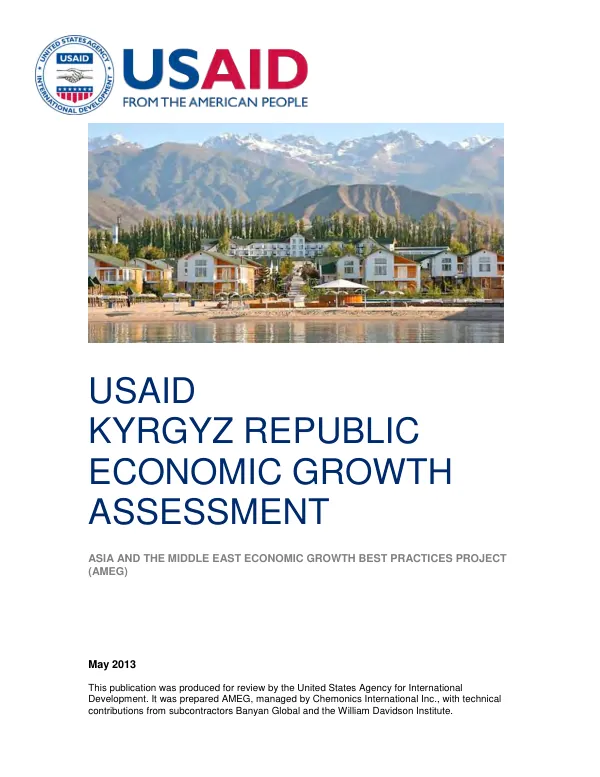
USAID Kyrgyz Republic Economic Growth Assessment
The Kyrgyz Republic is poised for rapid economic growth following political unrest in 2010 and subsequent elections in 2011.
2013 · 101 pages
Sign in to readA free account is required to download.
Abstract
The country's private sector faces key constraints that need to be addressed to support its renewed economic prospects. USAID/Kyrgyz Republic engaged the USAID Asia and the Middle East Economic Growth Best Practices Project (AMEG) to conduct an economic growth assessment. The purpose of the assessment was to review and propose recommendations to address select constraints in the business enabling environment and to increase the competitiveness of the tourism and textile sectors. The field assessment was conducted from March 30 to April 27, 2013, by a team of experts led by Douglas Muir, representing Chemonics International. The team conducted desk research, more than 190 interviews with government officials, private sector stakeholders, industry associations, and non-governmental organizations, and dozens of site visits to four different provinces. The assessment team developed specific, actionable recommendations to enhance the business enabling environment and improve the competitiveness of the tourism and textile sectors. The textile and apparel sector is an engine of job creation and one of the country's major export industries. The sector faces challenges such as limited access to finance, inadequate infrastructure, and a lack of skilled labor. The assessment team recommends improving access to finance for small and medium-sized enterprises (SMEs) through the development of a credit guarantee scheme and the establishment of a textile industry association. Additionally, the team suggests investing in infrastructure development, such as the construction of a new textile factory and the upgrading of existing ones. The tourism sector is also a significant contributor to the country's economy, with opportunities for growth in areas such as ecotourism and cultural heritage tourism. However, the sector faces challenges such as limited infrastructure, inadequate marketing, and a lack of skilled labor. The assessment team recommends improving infrastructure development, such as the construction of new hotels and the upgrading of existing ones. Additionally, the team suggests investing in marketing and promotion efforts to increase awareness of the country's tourism products and attractions. The business enabling environment is critical to supporting the growth of the private sector. The assessment team recommends improving the business enabling environment through the development of a one-stop shop for business registration and licensing, the establishment of a business ombudsman, and the improvement of the country's investment climate. Additionally, the team suggests investing in capacity building and training programs for government officials and private sector stakeholders to improve their understanding of the business enabling environment and their ability to support the growth of the private sector. The assessment team used the following criteria in proposing their recommendations for potential future activities that USAID might support. The proposed activities must respond to market demand, contribute to sustainable job creation, engage or collaborate with a capable implementing partner, impact areas beyond Bishkek, leverage prior or current assistance by the U.S. government and/or other donors, and represent a good opportunity for a Public Private Partnership (PPP). The team also suggests that the proposed activities should positively impact women and/or rural communities. The assessment team's recommendations are outlined in the report, which includes detailed narratives related to textiles, tourism, and the business enabling environment. The report also includes annexes that provide supplementary information on the team's interviews, reference material, resources employed, textile recommendations, business enabling environment recommendations, gold production, and timeline for conducting the assessment.