FHI360
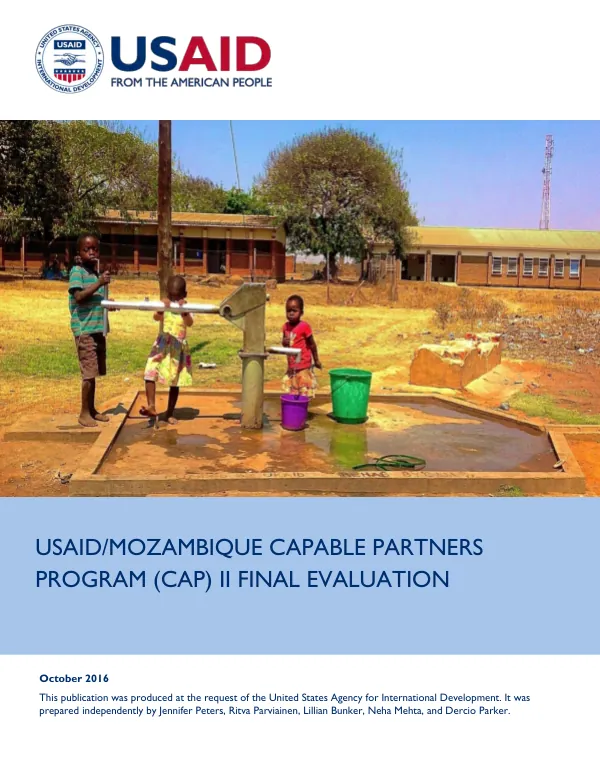
USAID/MOZAMBIQUE CAPABLE PARTNERS PROGRAM (CAP) II FINAL EVALUATION
The USAID/Mozambique Capable Partners Program (CAP) II was a five-year initiative aimed at strengthening leading Mozambican organizations and networks in the areas of HIV and capacity development.
2016 · 169 pages
Sign in to readA free account is required to download.
Abstract
The program was implemented from 2011 to 2016 and received funding from the United States Agency for International Development (USAID). The CAP II project focused on building the capacity of local partners to increase the number and quality of HIV services they provided. The program's approach involved providing technical assistance, training, and grants to partner organizations. The CAP II project also aimed to improve the capacity of local partners to integrate gender-based violence (GBV) into their strategic and programmatic planning. The evaluation of the CAP II project was conducted by a team of experts from GH Pro, a global health performance cycle improvement project. The evaluation aimed to assess the effectiveness of the CAP II project in achieving its objectives and to identify areas for improvement. The evaluation team collected data through a combination of surveys, interviews, and document reviews. The evaluation found that the CAP II project had made significant progress in building the capacity of local partners to increase the number and quality of HIV services they provided. The project's technical capacity-building initiatives had improved grantee partners' capacity to increase the number and/or quality of HIV services they provided. The evaluation also found that the CAP II project had increased the capacity of local partners to integrate GBV into their strategic and programmatic planning. However, the evaluation also identified several challenges and constraints that affected the project's implementation. These included limited resources, inadequate infrastructure, and a lack of coordination among stakeholders. The evaluation team recommended that USAID consider these challenges and constraints when designing future projects. The evaluation also found that the CAP II project had made significant progress in increasing the sustainability of local partners. The project's support had increased the financial, technical, and institutional sustainability of local partners over time. The evaluation team recommended that USAID continue to support the development of local partners' capacity to increase their sustainability. The CAP II project had a significant impact on the HIV service delivery landscape in Mozambique. The project's support had increased the number and quality of HIV services provided by local partners. The project's capacity-building initiatives had improved the capacity of local partners to integrate GBV into their strategic and programmatic planning. The evaluation team recommended that USAID consider the following short-term recommendations for future indicator measurements, future organizational development (OD) efforts, initiatives, and project design, and to increase sustainability. The team also recommended that USAID continue to support the development of local partners' capacity to increase their sustainability. The CAP II project was a significant investment in the HIV service delivery landscape in Mozambique. The project's support had increased the number and quality of HIV services provided by local partners. The project's capacity-building initiatives had improved the capacity of local partners to integrate GBV into their strategic and programmatic planning. The evaluation team's recommendations provide a roadmap for future investments in the HIV service delivery landscape in Mozambique.