ICRC
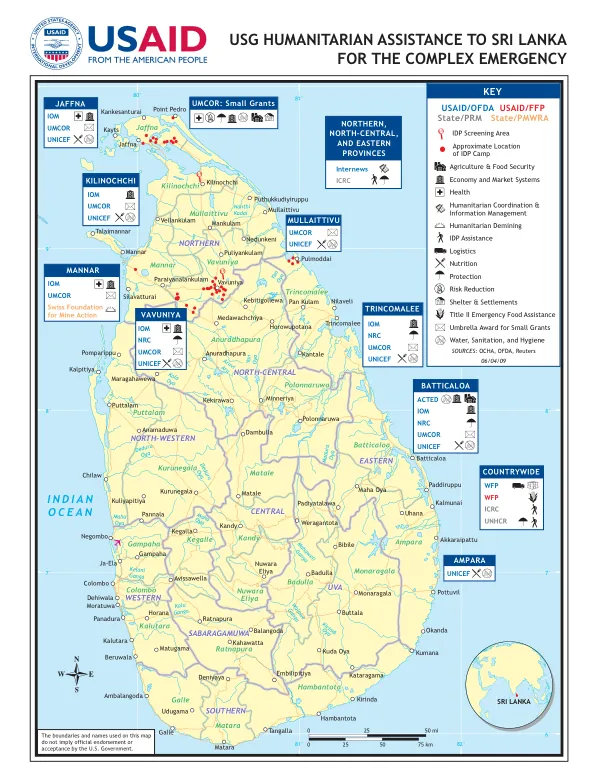
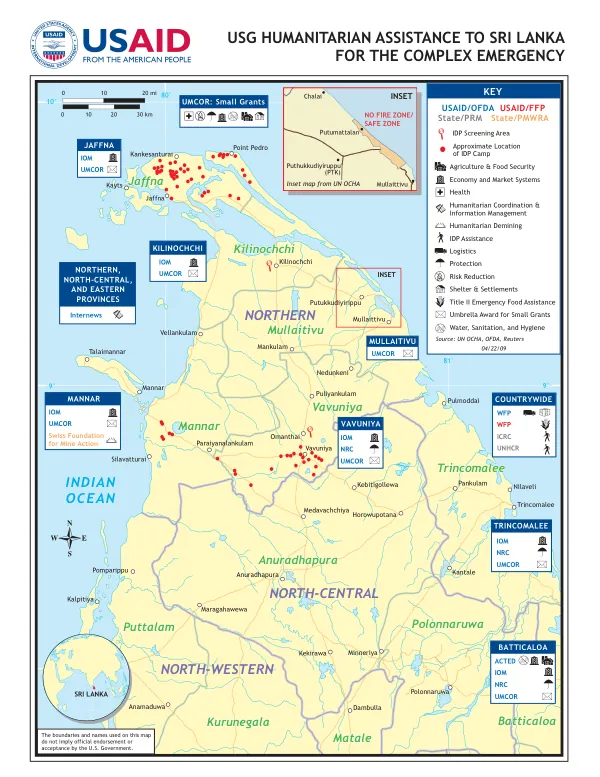
USAID/OFDA Sri Lanka Program Map 4/22/2009
The complex emergency in Sri Lanka, particularly in the Northern Province, has resulted in a significant displacement of people.
2009 · 2 pages
Sign in to readA free account is required to download.
Abstract
As of April 22, 2009, an estimated 81,000 to 100,000 internally displaced persons (IDPs) escaped the no-fire zone, while 50,000 to 100,000 IDPs remained trapped in the area. The majority of these IDPs were from the Mullaitivu District, with some also from the Kilinochchi and Mannar Districts. The IDPs who escaped the no-fire zone were primarily from the Mullaitivu District, with some also from the Kilinochchi and Mannar Districts. The approximate location of IDP camps in Jaffna, Mannar, and Vavuniya districts was reported to be around 81,075 IDPs, with 61,000 IDPs in camps prior to April 20. The IDPs were primarily from the Mullaitivu District, with some also from the Kilinochchi and Mannar Districts. The recent movement of IDPs in Sri Lanka was a result of the ongoing conflict between the government and the Liberation Tigers of Tamil Eelam (LTTE). The no-fire zone, established by the Sri Lankan government, was a designated area where civilians were supposed to be safe from the conflict. However, the area was heavily affected by the conflict, resulting in the displacement of a large number of people. The humanitarian response to the crisis in Sri Lanka was led by various international organizations, including the United Nations Office for the Coordination of Humanitarian Affairs (OCHA), the United States Agency for International Development (USAID), and the International Committee of the Red Cross (ICRC). These organizations provided assistance to the IDPs, including food, shelter, and medical care. The humanitarian response was also supported by various non-governmental organizations (NGOs), including the Norwegian Refugee Council (NRC), the International Organization for Migration (IOM), and the United Nations High Commissioner for Refugees (UNHCR). The humanitarian situation in Sri Lanka remained critical, with ongoing conflict and displacement affecting a large number of people. The international community continued to provide assistance to the affected population, with a focus on providing life-saving assistance to those in need.