USAID DEC
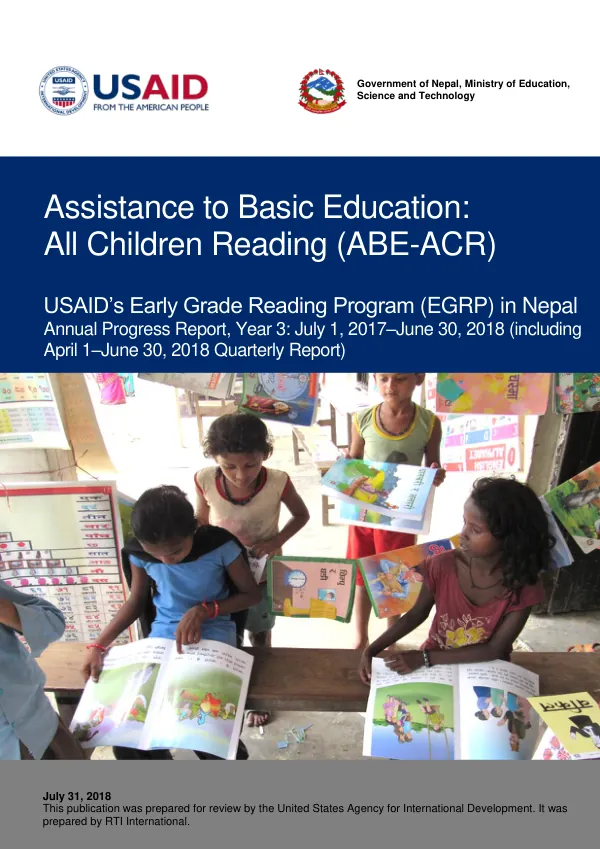
USAID’s Early Grade Reading Program (EGRP) in Nepal Annual Progress Report, Year 3: July 1, 2017–June 30, 2018 (including April 1–June 30, 2018 Quarterly Report)
Sign inRTI INTERNATIONAL
USAID’s Early Grade Reading Program (EGRP) in Nepal Annual Progress Report, Year 3: July 1, 2017–June 30, 2018 (including April 1–June 30, 2018 Quarterly Report)
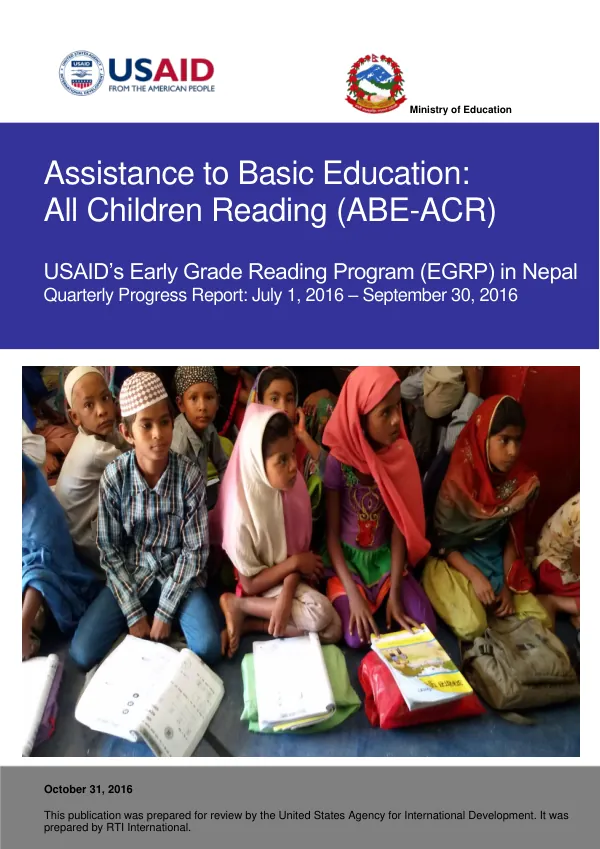
The Early Grade Reading Program (EGRP) in Nepal is a USAID-funded initiative aimed at improving early grade reading instruction in the country.
2018 · 118 pages
Sign in to readA free account is required to download.
Abstract
The program is implemented by RTI International and focuses on three intermediate results: Improved Early Grade Reading Instruction, Improved National and District Early Grade Reading Service Delivery, and Increased Family and Community Support for Early Grade Reading. The program's implementation progress is reported in the Annual Progress Report, Year 3, which covers the period from July 1, 2017, to June 30, 2018. According to the report, the program has made significant progress in achieving its intermediate results. In terms of Improved Early Grade Reading Instruction, the program has trained over 2,500 teachers in reading instruction methods, and 60% of the demonstration plots established in 15 communities have shown yield improvements of 60% when applying the recommended practices. The program has also made progress in Improved National and District Early Grade Reading Service Delivery. The report notes that the number of peer education refresher trainings and participants in five Cohort 1 districts has increased, and the number of meetings with Local Education Units in six Cohort 1 districts has also increased. Additionally, the program has established a system for monitoring and evaluating the progress of the program, which includes tracking indicators such as the number of students who participate in the CB-EGRA and the number of ward-level advocacy and awareness campaigns. In terms of Increased Family and Community Support for Early Grade Reading, the program has made progress in engaging families and communities in the program. The report notes that the number of "best parents" selection events and number of participants in Cohort 1 districts has increased, and the number of events and participants in EGRA forums in three Cohort 1 districts has also increased. The program has also made progress in implementing cross-cutting activities, including gender and special-needs education. The report notes that the program has established a system for tracking the participation of girls and boys in the program, and has also established a system for tracking the participation of children with special needs. The program's management and administrative issues are also reported in the Annual Progress Report, Year 3. The report notes that the program has made progress in addressing the comments of the Contracting Officer's Representative (COR) from the last quarterly report. The program has also established a system for tracking the progress of the program and has made progress in implementing the program's sustainability and exit strategy. The program's lessons learned and what USAID does not know that it needs to are also reported in the Annual Progress Report, Year 3. The report notes that the program has learned the importance of engaging families and communities in the program, and has also learned the importance of establishing a system for tracking the progress of the program. The report also notes that USAID does not know that it needs to establish a system for tracking the long-term impact of the program. Overall, the Early Grade Reading Program in Nepal has made significant progress in achieving its intermediate results and has established a system for tracking the progress of the program. The program's management and administrative issues are also reported in the Annual Progress Report, Year 3, and the program has made progress in addressing the comments of the Contracting Officer's Representative (COR) from the last quarterly report.