USAID DEC
USAID's LuzonHealth Project: Improving Demand for and Supply of Family Planning and Maternal, Neonatal, Child Health and Nutrition (FP/MNCHN) Services in Benguet and Baguio City
Sign inRTI INTERNATIONAL
USAID's LuzonHealth Project: Improving Demand for and Supply of Family Planning and Maternal, Neonatal, Child Health and Nutrition (FP/MNCHN) Services in Benguet and Baguio City
The Province of Benguet and the City of Baguio are located in the Cordillera Administrative Region of the Philippines.
2018 · 2 pages
Sign in to readA free account is required to download.
Abstract
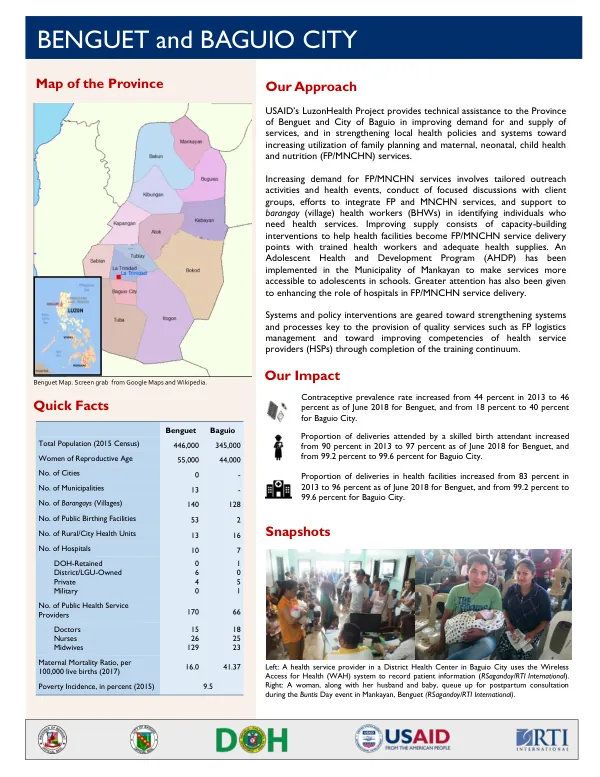
The Province of Benguet has a total population of 446,000, with 55,000 women of reproductive age. The City of Baguio has a total population of 345,000, with 44,000 women of reproductive age. Benguet has 13 municipalities, 140 barangays, and 53 public birthing facilities, while Baguio has no cities, 128 barangays, and 2 public birthing facilities. The Department of Health (DOH) has a significant presence in both Benguet and Baguio, with 10 hospitals in Benguet and 7 in Baguio. The hospitals in Benguet are owned by the DOH, local government units, and private entities, while those in Baguio are owned by the DOH and local government units. There are 170 public health service providers in Benguet, including doctors, nurses, and midwives, while Baguio has 66 public health service providers. The Maternal Mortality Ratio in Benguet is 16.0 per 100,000 live births, while in Baguio it is 41.37 per 100,000 live births. The Poverty Incidence in Benguet is 9.5 percent, while in Baguio it is not specified. USAID's LuzonHealth Project provides technical assistance to the Province of Benguet and the City of Baguio to improve demand for and supply of family planning and maternal, neonatal, child health, and nutrition (FP/MNCHN) services. The project aims to increase the contraceptive prevalence rate, improve the proportion of deliveries attended by skilled birth attendants, and increase the proportion of deliveries in health facilities. The project's approach involves increasing demand for FP/MNCHN services through tailored outreach activities, health events, and focused discussions with client groups. It also involves improving supply by capacity-building interventions to help health facilities become FP/MNCHN service delivery points with trained health workers and adequate health supplies. The project has implemented several key interventions, including the Adolescent Health and Development Program (AHDP) in Mankayan Municipality, which aims to make adolescents and youth in the municipality well-informed, empowered, and able to access quality comprehensive health care services in an adolescent and youth-friendly environment. The project has also supported the training of health service providers (HSPs) in various skills, including family planning competency-based training, bilateral tubal ligation, lactation management, basic emergency obstetric and newborn care, and postpartum intrauterine device insertion. The project has also ensured that FP commodities are available and delivered on time by operationalizing a system for recording and tracking the flow of commodities. The project has also strengthened systems and processes key to the provision of quality services, particularly health information systems, FP logistics management, and health financing. The project has built the capacity of health facilities as FP service delivery points and made FP/MNCHN services more accessible to adolescents in schools. The project has achieved several successes, including an increase in the contraceptive prevalence rate from 44 percent in 2013 to 46 percent as of June 2018 for Benguet, and from 18 percent to 40 percent for Baguio City. The proportion of deliveries attended by skilled birth attendants has also increased from 90 percent in 2013 to 97 percent as of June 2018 for Benguet, and from 99.2 percent to 99.6 percent for Baguio City. The proportion of deliveries in health facilities has also increased from 83 percent in 2013 to 96 percent as of June 2018 for Benguet, and from 99.2 percent to 99.6 percent for Baguio City. The project has also assisted 12 other municipalities in Benguet in organizing their respective Adolescent and Youth Health Program Councils, and has seen a decline in the number of teenage pregnancies in the entire Province from 782 cases in 2015 to 352 cases as of July 2018.
Related documents
Documents in this collection
 2018
2018USAID DEC
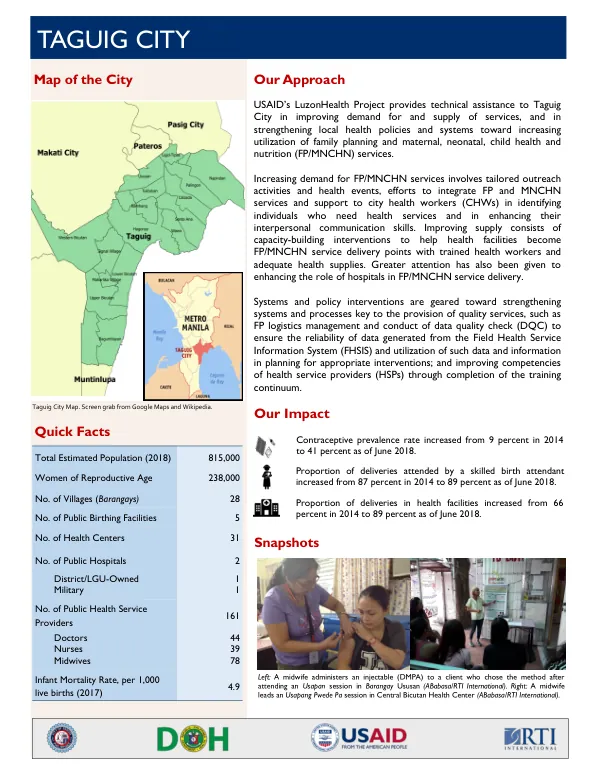
USAID LuzonHealth Project: Improving Demand for and Supply of Family Planning and Maternal, Neonatal, Child Health and Nutrition (FP/MNCHN) Services in Taguig City
Open record 2018
2018USAID DEC