USAID DEC
USAID’s LuzonHealth Project: Improving Demand for and Supply of Family Planning and Maternal, Neonatal, Child Health and Nutrition (FP/MNCHN) Services in Oriental Mindoro
Sign inRTI INTERNATIONAL
USAID’s LuzonHealth Project: Improving Demand for and Supply of Family Planning and Maternal, Neonatal, Child Health and Nutrition (FP/MNCHN) Services in Oriental Mindoro
The Province of Oriental Mindoro is a key focus area for the USAID's LuzonHealth Project, which aims to improve demand for and supply of family planning and maternal, neonatal, child health, and nutrition (FP/MNCHN) services.
2018 · 2 pages
Sign in to readA free account is required to download.
Abstract
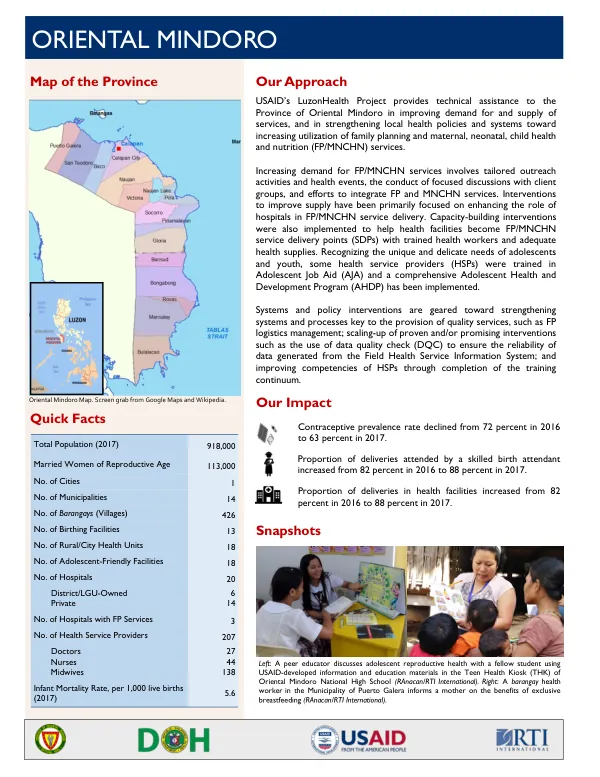
The project provides technical assistance to the province to strengthen local health policies and systems. The project's approach involves increasing demand for FP/MNCHN services through tailored outreach activities, health events, and focused discussions with client groups. Interventions to improve supply have focused on enhancing the role of hospitals in FP/MNCHN service delivery, including training health service providers in FP competency-based training and providing them with adequate health supplies. Capacity-building interventions have been implemented to help health facilities become FP/MNCHN service delivery points with trained health workers and adequate health supplies. Recognizing the unique needs of adolescents and youth, some health service providers have been trained in Adolescent Job Aid (AJA) and a comprehensive Adolescent Health and Development Program (AHDP) has been implemented. Systems and policy interventions are geared toward strengthening systems and processes key to the provision of quality services, such as FP logistics management and scaling-up of proven and/or promising interventions. The project has also supported the training of health service providers in various skills, including Basic Emergency Obstetric and Newborn Care (BEmONC), Family Planning Competency-Based Training Level 1 (FPCBT1), and Lactation Management. The project has also focused on ensuring FP commodities are available and delivered on time by operationalizing a system for recording and tracking the flow of commodities. As a result, the number of clients availing of FP services from the three targeted public hospitals has continuously increased. At Oriental Mindoro Provincial Hospital, there were 741 PPIUD and 374 BTL clients in 2017, from only 21 and 38 clients in 2014, respectively. The project has also integrated FP and ANC messages in child immunization services, organized Usapan sessions, and supported the establishment of FP in public hospitals. Additionally, the project has built the capacity of health facilities as FP service delivery points and made FP/MNCHN services more accessible to adolescents in schools and communities. The project has also strengthened systems and processes key to the provision of quality services, particularly health information systems, FP logistics management, and health financing. All 18 Rural Health Units (RHUs) in the Province are regularly conducting Data Quality Check (DQC), while 16 RHUs are implementing the Supply Management and Recording System (SMRS). The project has also built competencies of health service providers by improving the training system, which encompasses training needs assessment, conduct of training, supportive supervision, and post-training evaluation (PTE). Since 2013, 30 health service providers trained in PPIUD Insertion, 12 in Interval IUD Insertion, and 60 in BEmONC have undergone a PTE. Additionally, five health service providers trained as trainers for PPIUD have undergone a PTE and were certified. The project's interventions have resulted in significant improvements in FP/MNCHN services in the Province of Oriental Mindoro. The contraceptive prevalence rate declined from 72 percent in 2016 to 63 percent in 2017, while the proportion of deliveries attended by a skilled birth attendant increased from 82 percent in 2016 to 88 percent in 2017. The proportion of deliveries in health facilities also increased from 82 percent in 2016 to 88 percent in 2017.
Related documents
Documents in this collection
 2018
2018USAID DEC
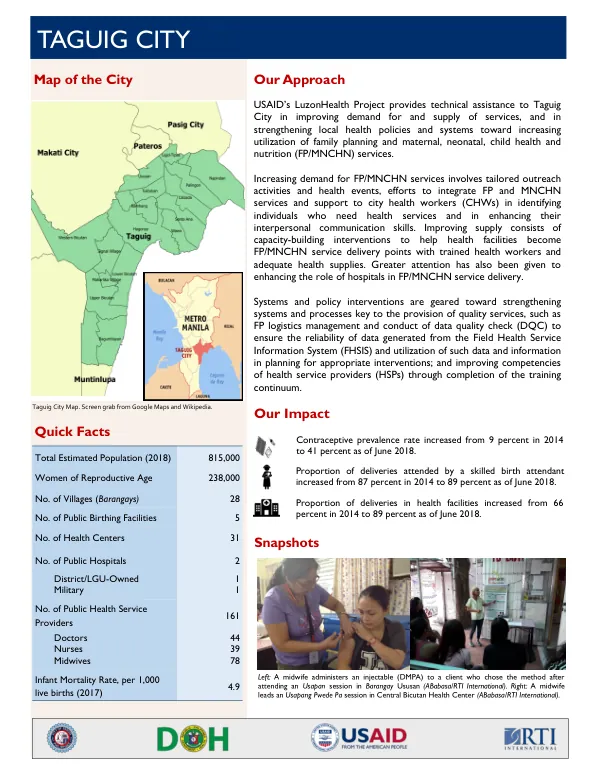
USAID LuzonHealth Project: Improving Demand for and Supply of Family Planning and Maternal, Neonatal, Child Health and Nutrition (FP/MNCHN) Services in Taguig City
Open record 2018
2018USAID DEC