USAID DEC
USAID’s P&F Program Supports Forest Conservation and Carbon Market Access in Colombia
Sign inUSAID
USAID’s P&F Program Supports Forest Conservation and Carbon Market Access in Colombia
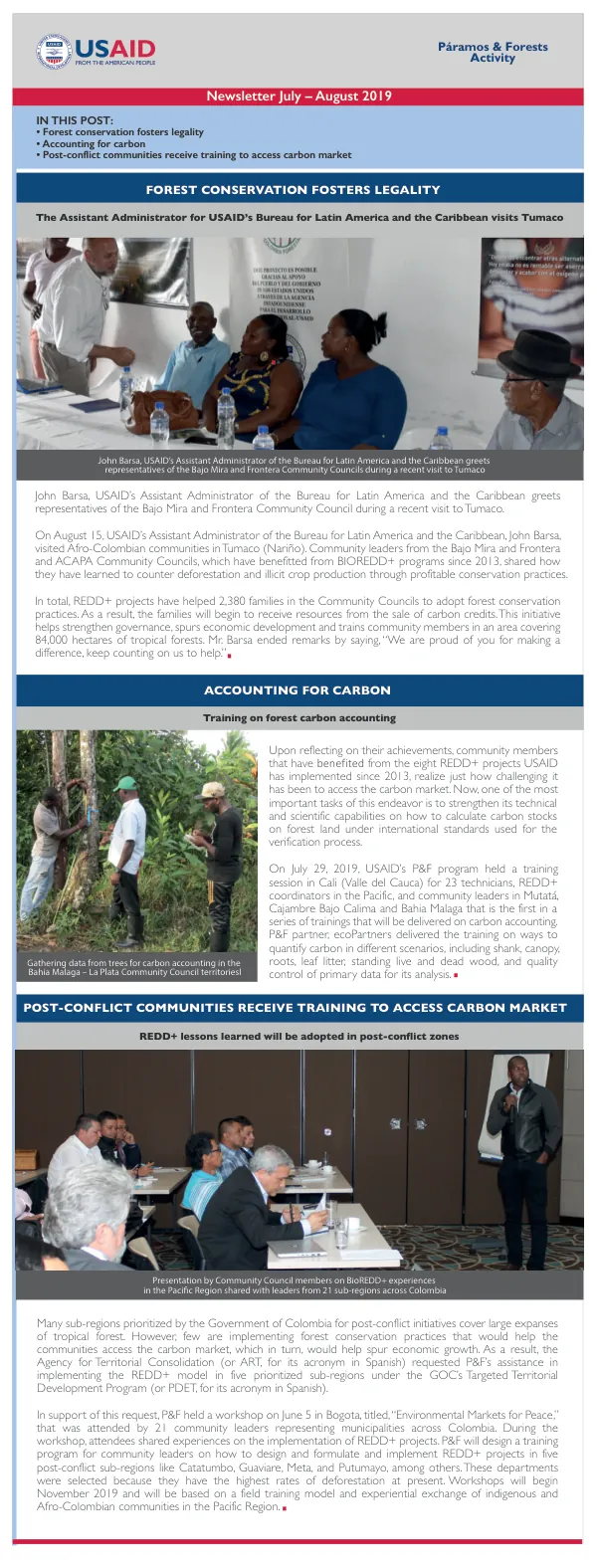
John Barsa, USAID's Assistant Administrator of the Bureau for Latin America and the Caribbean, visited Afro-Colombian communities in Tumaco, Nariño, on August 15.
2019 · 1 pages
Sign in to readA free account is required to download.
Abstract
Community leaders from the Bajo Mira and Frontera Community Councils, which have benefited from BIOREDD+ programs since 2013, shared their experiences with profitable conservation practices that counter deforestation and illicit crop production. These practices have been adopted by 2,380 families in the Community Councils, enabling them to receive resources from the sale of carbon credits. The initiative aims to strengthen governance, spur economic development, and train community members in an area covering 84,000 hectares of tropical forests. The BIOREDD+ projects have been implemented in the region since 2013, with the goal of promoting forest conservation and reducing deforestation. The projects have helped to strengthen the technical and scientific capabilities of community members in calculating carbon stocks on forest land, in accordance with international standards used for verification processes. This has been a challenging task, as accessing the carbon market has been difficult for community members. However, with the support of USAID's P&F program, community leaders have received training on carbon accounting, enabling them to quantify carbon in different scenarios and analyze primary data. The P&F program has held a series of trainings on carbon accounting, with the first session taking place in Cali, Valle del Cauca, on July 29, 2019. The training was attended by 23 technicians, REDD+ coordinators, and community leaders from the Pacific Region. The training focused on ways to quantify carbon in different scenarios, including shank, canopy, roots, leaf litter, standing live and dead wood, and quality control of primary data for analysis. The program aims to design a training program for community leaders on how to design and formulate and implement REDD+ projects in five post-conflict sub-regions, including Catatumbo, Guaviare, Meta, and Putumayo. The Government of Colombia has prioritized post-conflict initiatives in sub-regions that cover large expanses of tropical forest. However, few of these sub-regions are implementing forest conservation practices that would help communities access the carbon market and spur economic growth. In response to this challenge, the Agency for Territorial Consolidation (ART) requested P&F's assistance in implementing the REDD+ model in five prioritized sub-regions under the Government of Colombia's Targeted Territorial Development Program (PDET). P&F will design a training program for community leaders on how to design and formulate and implement REDD+ projects in these sub-regions, with workshops beginning in November 2019.