COUNCIL FOR SOCIAL DEVELOPMENT
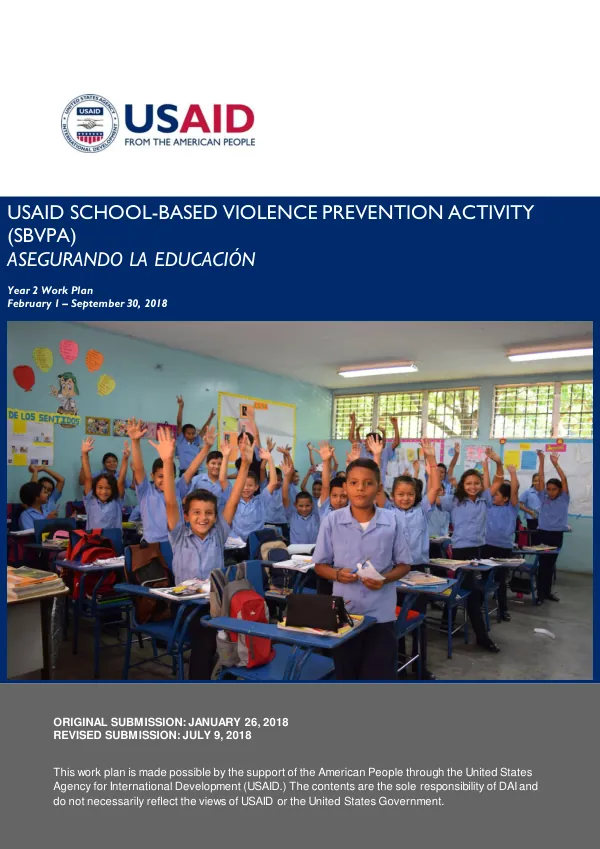
USAID School-Based Violence Prevention Activity (SBVPA) Year 2 Work Plan
The USAID School-Based Violence Prevention Activity (SBVPA), also known as Asegurando la Educación, is a five-year initiative funded by USAID with a budget of $20 million.
2018 · 66 pages
Sign in to readA free account is required to download.
Abstract
The project aims to address school-based violence (SBV) that hinders education delivery and its goals of access, retention, and learning. Asegurando seeks to use education and school processes to contribute to violence prevention in target communities. The project has four strategic objectives: to improve schools' ability to reduce SBV through the creation of safe learning environments; to strengthen local networks that increase school safety; to increase the capacity of the Ministry of Education (MOE) and social protection actors to prevent, respond to, report on, and monitor SBV; and to lower risk factors and enhance protective factors for students qualifying for secondary prevention services. Asegurando is implemented by DAI Global, LLC, with support from Partners of the Americas, under a period of performance from February 23, 2017, to February 22, 2022. The project strengthens education systems to address SBV in schools, enhancing the capacity of Government of Honduras (GOH) institutions, such as the Ministry of Education (MOE), the Ministry of Security, and other key social network actors at the national and municipal level, as well as among local civil society organizations (CSOs). The project's geographic focus is on five target cities in Honduras: Tegucigalpa, San Pedro Sula, Choloma, La Ceiba, and Tela. Asegurando works in targeted schools over the life of the project, responding to USAID's Education Strategy Goal #3 of increased equitable access to education in crisis and conflict environments. The project's implementation is guided by a results framework and theory of change, which outlines the expected outcomes and activities to achieve the project's objectives. The results framework includes indicators for measuring progress, such as the reduction of school-based violence, improvement in school safety, and increased capacity of MOE and social protection actors. Asegurando's Year 2 Work Plan, spanning from February 1 to September 30, 2018, outlines the project's activities and objectives for the period. The plan includes four main objectives: to improve schools' ability to reduce SBV; to strengthen local networks that increase school safety; to increase the capacity of MOE and social protection actors; and to lower risk factors and enhance protective factors for students qualifying for secondary prevention services. The project's activities for Year 2 include the implementation of school-based violence prevention programs, capacity building for MOE and social protection actors, and the establishment of local networks to increase school safety. The project also includes a monitoring, evaluation, and learning (MEL) component to track progress and identify areas for improvement. Asegurando's sustainability plan aims to ensure the project's long-term impact by building the capacity of local institutions and promoting ownership of the project's outcomes. The project's coordination with other USAID activities and stakeholders is also an essential aspect of its implementation. The project's budget for Year 2 is outlined in the work plan, which includes funding for personnel, activities, and other expenses. The budget is managed in accordance with USAID's financial regulations and guidelines. Asegurando's environmental compliance plan ensures that the project's activities do not harm the environment and that the project's operations are environmentally sustainable. The project's MEL component tracks progress and identifies areas for improvement, ensuring that the project's activities are effective and efficient. The project's collaboration, learning, and adapting (CLA) approach enables the project team to learn from experiences, adapt to changing circumstances, and share knowledge with stakeholders. The project's external communications approach ensures that the project's outcomes and achievements are communicated to stakeholders, including USAID, the Government of Honduras, and local communities. Asegurando's GIS and ICT components support the project's activities, including the use of geographic information systems (GIS) and information and communication technologies (ICT) to track progress and identify areas for improvement. The project's project management plan outlines the project's organizational structure, roles, and responsibilities, ensuring effective implementation and management of the project. The project's annexes, including the Year 1 and 2 school cohorts list, activity timeline and cost estimates, and budget overview, provide additional information on the project's implementation and management.