USAID DEC
USAID Supports the International Organization for Migration (IOM) in Colombia through the Recruitment Prevention and Reintegration (RPR) Program
Sign inGOVERNMENT OF COLOMBIA
USAID Supports the International Organization for Migration (IOM) in Colombia through the Recruitment Prevention and Reintegration (RPR) Program
The Colombian government's efforts to demobilize and reintegrate former combatants from the Revolutionary Armed Forces of Colombia (FARC) are ongoing.
2016 · 5 pages
Sign in to readA free account is required to download.
Abstract
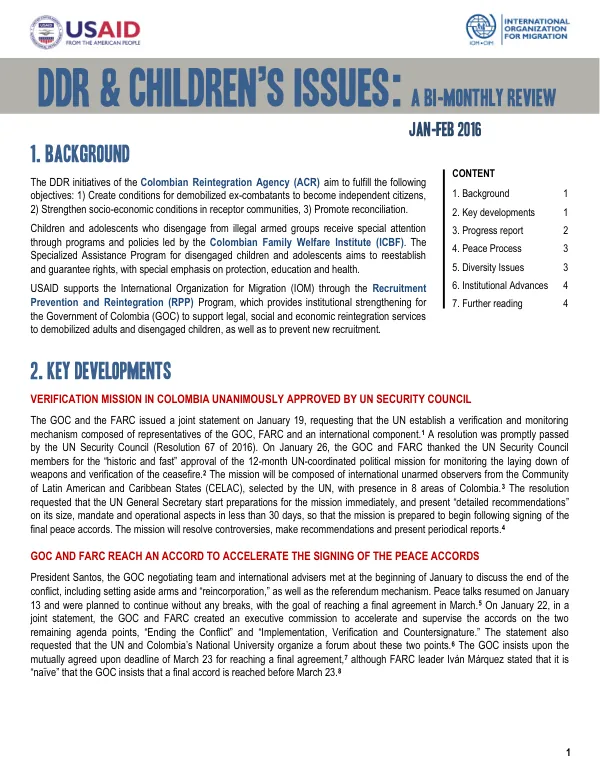
The FARC's demobilization process is being supported by the International Organization for Migration (IOM) through the Recruitment Prevention and Reintegration (RPR) Program, which is funded by the United States Agency for International Development (USAID). The program aims to provide institutional strengthening for the Government of Colombia (GOC) to support legal, social, and economic reintegration services to demobilized adults and disengaged children. The GOC's Colombian Reintegration Agency (ACR) is responsible for supporting demobilized adults through its DDR initiatives. The objectives of these initiatives include creating conditions for demobilized ex-combatants to become independent citizens, strengthening socio-economic conditions in receptor communities, and promoting reconciliation. The Colombian Family Welfare Institute (ICBF) provides special attention to children and adolescents who disengage from illegal armed groups, recognized as victims, through its Specialized Assistance Program. The peace process between the GOC and the FARC has been marked by significant developments in July 2016. On July 18th, Colombia's Constitutional Court approved the plebiscite for the peace accords, which will allow citizens to vote on whether to legitimize or reject the accords. The plebiscite is expected to take place around October 2016, and a positive vote will catalyze the constitutional reforms process required to implement the accords. The Gender Sub-commission, established in September 2014, has made significant contributions to the peace process. The commission has received testimonies and recommendations from victims, women's and LGBT organizations, experts on sexual violence, and female ex-combatants from other countries. The commission's contributions include differential access to educational opportunities, land ownership, and mechanisms for closing the gender gap with regards to land ownership and retention. A confrontation between the FARC and the GOC broke the June 23rd bilateral ceasefire on July 8th. The confrontation occurred when FARC members inadvertently traveled outside of the agreed-upon zones, using incorrect coordinates. No Colombian Army soldiers or civilians were harmed in the encounter, and uncertainty remains as to whether any FARC members were injured. The First and Seventh Fronts of the FARC announced that they do not plan to lay down their arms in the event of a peace accord, citing economic interests as the motivation for their decision. The United States has committed $33 million to demining efforts in Colombia, with the goal of clearing landmines and other explosive remnants of war. The demining efforts are part of the peace process with the FARC and are aimed at facilitating the safe return of demobilized combatants to their communities. The Colombian government has also taken steps to promote the peace process with the ELN, naming Carlos Velandia and Gerardo Bermúdez as representatives for the peace talks. The two men were previously members of the guerrilla group and will still be required to attend their own judicial proceedings, which include charges of kidnapping, homicide, robbery, and participation in the ELN.