DAI GLOBAL, LLC
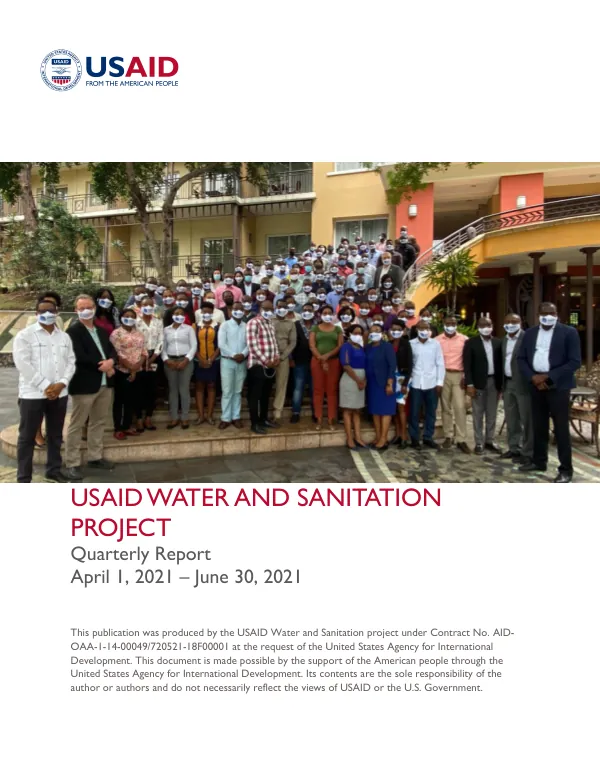
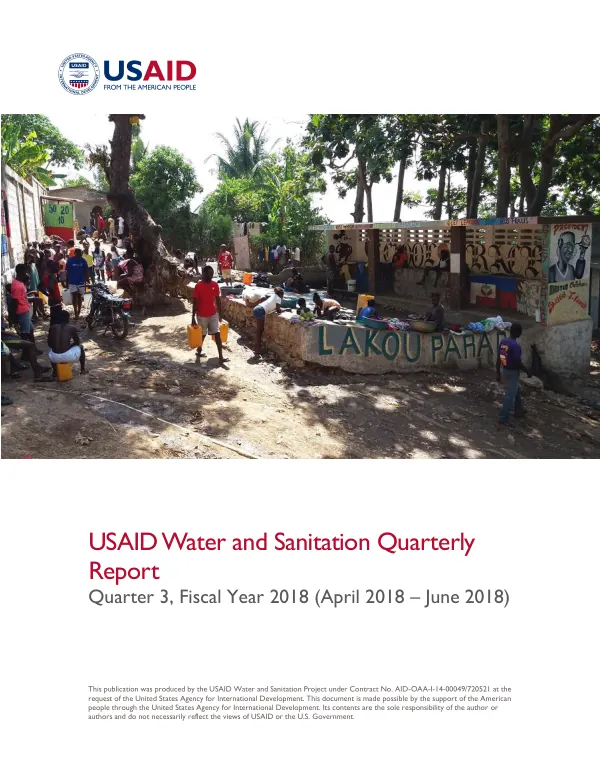
USAID Water and Sanitation Project Quarterly Report
The USAID Water and Sanitation project in Haiti aims to increase access to water and sanitation services in urban areas where needs are greatest.
2018 · 23 pages
Sign in to readA free account is required to download.
Abstract
The project targets three communes identified by the Government of Haiti as priority cholera "hotspot – Type A" communes (Cap Haitien, Croix-des-Bouquets and Mirebalais) and two communes recovering from Hurricane Matthew (Les Cayes and Jeremie). The project focuses on increasing access to water and sanitation services while building the enabling environment to sustain those services. The project is organized into three mutually reinforcing components: Component 1 - Increased access to sustainable water supply services, Component 2 - Increased access to sustainable sanitation services, and Component 3 - Strengthened enabling environment for sustainable delivery, operation, and maintenance of water, sanitation, and hygiene (WASH) services. Additionally, the project will launch an enterprise acceleration fund (EAF) to stimulate the WSS market and promote the strengthening of local actors integral to sustainable water and sanitation services. During the third quarter of FY18, the project launched several important field activities advancing towards full-scale implementation. The main focus was on foundational assessment and roadmap activities, including data collection, systems mapping and assessment, and dialogue, as well as assessments regarding the Direction Nationale de l'Eau Potable et de l'Assainissement's (DINEPA) capacity for monitoring. The project also completed the basic mobilization of key long-term technical assistance staff and fully established offices in Cap Haitien and Port-au-Prince. The project submitted four technical deliverables during the reporting period: the first and second quarterly report, the EAF manual, the initial project-level environmental monitoring and mitigation plan (EMMP), and the environmental scoping statement. The quarterly report outlined the project's operational and technical start-up activities, while the EAF manual defines the goal and use of the EAF funds budgeted under the project. The EMMP provides the framework for environmental analyses, mitigation measures, and monitoring during the life of the project, and the environmental scoping statement describes how the project will complete a comprehensive programmatic environmental assessment (PEA) to address potential environmental issues. The project's foundational activities comprise two specific steps: data collection, systems mapping and assessment, and dialogue, and commune level WSS roadmaps. These steps emphasize initial research, information gathering, and dialogue with stakeholders to inform the project's implementation. The project's progress on work plan implementation to date is discussed in the report, which also covers key meetings with stakeholders, government counterparts, and other donors in the WASH sector in Haiti. The project's enterprise acceleration fund (EAF) aims to stimulate the WSS market and promote the strengthening of local actors integral to sustainable water and sanitation services. The EAF manual defines the goal and use of the EAF funds budgeted under the project, and outlines the mechanisms for accessing the funds and leveraging them to achieve contract and annual workplan objectives. The project's environmental monitoring and mitigation plan (EMMP) provides the framework for environmental analyses, mitigation measures, and monitoring during the life of the project, and the environmental scoping statement describes how the project will complete a comprehensive programmatic environmental assessment (PEA) to address potential environmental issues. The project's progress on foundational activities, including data collection, systems mapping and assessment, and dialogue, and commune level WSS roadmaps, is discussed in the report. The project's work plan implementation to date is also discussed, including key meetings with stakeholders, government counterparts, and other donors in the WASH sector in Haiti. The report provides an overview of the project's progress and achievements during the third quarter of FY18, and outlines the project's plans and activities for the next quarter.